Collective Problem-Solving Capacity, Trust, and O-Ring Team Productivity 1.0.0
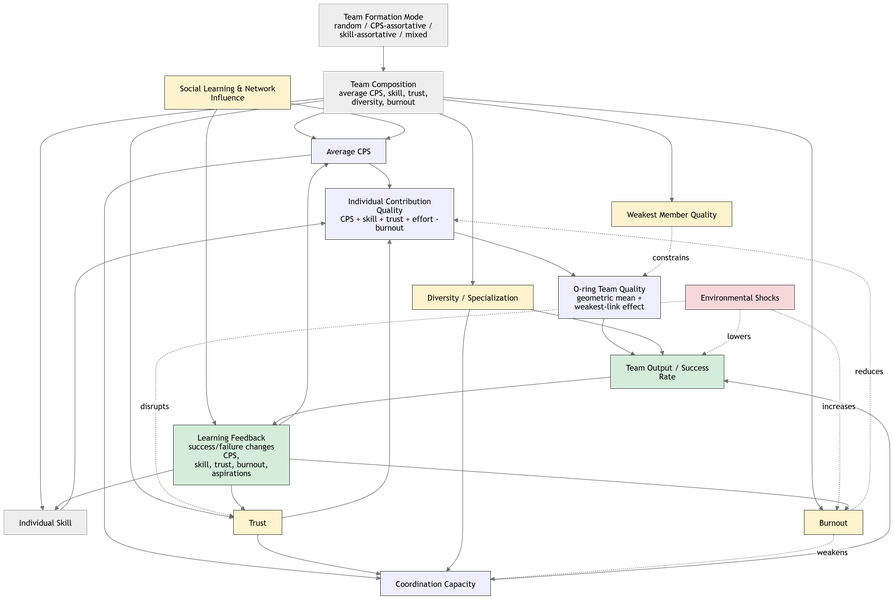
This is a NetLogo 7.0.1 agent-based model of interdependent team productivity under O-ring production logic. The model asks when collective problem-solving capacity (CPS) improves team output and when its effect is constrained by trust, burnout, specialization diversity, weak-link quality, and team-formation rules. Agents are heterogeneous in skill, CPS, trust, burnout, effort, learning rate, openness, specialization, adaptability, and aspiration. Each tick forms temporary teams, computes individual contribution quality, combines contributions through a geometric O-ring production function with an explicit weakest-link term, records output and success, and updates agents through feedback, learning, trust change, burnout, recovery, and turnover. The paper follows the ODD protocol, reports exact implementation equations, and analyzes six BehaviorSpace experiments with 50 stochastic repetitions per condition. Scenario results show that CPS is beneficial but not sufficient: productivity is highest when CPS is combined with trust, low burnout, effective coordination, and a reliable weakest-link floor. Diversity yields only modest gains at low CPS but larger gains when CPS is high. Formation-mode results are especially informative because mixed CPS-skill formation maximizes total output, whereas random formation has the highest binary success rate, showing that output magnitude and threshold success can diverge. The study contributes a transparent computational mechanism linking collective intelligence with O-ring production and identifies boundary conditions under which high-CPS teams can still be limited by weak links and interdependence.
Release Notes
This subsection gives the analytical structure of the implementation in readable notation. The notation follows the NetLogo code directly, with clip(x, a, b) indicating lower and upper bounding. For agent i in team j, C is CPS, S is skill, T is trust, B is burnout, E is effort multiplier, K is task complexity, and bars indicate team averages.
• Trust-mediated CPS: C_i^T = C_i [1 + theta_T (((T_i + T_bar_j) / 2) - 0.5)].
• Complexity-adjusted CPS: C_i = C_i^T [1 + 0.25 K C_i].
• Normalized effort: E_i = clip((E_i - 0.60) / 0.75, 0, 1).
• Raw contribution quality: r_i = w_C C_i + w_S S_i + w_T ((T_i + T_bar_j) / 2) + w_E E_i.
• Burnout-adjusted contribution quality: q_i = clip(r_i [1 - beta_B B_i], 0.01, 0.99).
• Geometric quality: G_j = exp(mean_i ln(max(q_i, 0.0001))).
• O-ring team quality: Q_j = clip(G_j^alpha min(q_i)^lambda, 0, 1).
• Coordination factor: Z_j = clip((1 + gamma C_bar_j T_bar_j) / ((1 + omega max(0, n_j - n*) (1 + K)) (1 + 0.40 B_bar_j K)), 0.20, 2.20).
• Diversity index: D_j = sqrt((Var(specialization)_j + Var(skill)_j) / 2).
• Diversity factor: F_Dj = clip(1 + b_D D_j C_bar_j - c_D D_j (1 - C_bar_j) K, 0.65, 1.45).
• Team output: Y_j = max(0, V_0 n_j^eta Q_j Z_j F_Dj F_Sj). Success_j = 1 if Y_j >= tau, otherwise 0.
The feedback submodel updates agents after success or failure. On success, skill, CPS, and trust increase toward their upper bounds. On failure, CPS can still increase when agents are open and adaptable, but trust falls with repeated failures. Burnout increases when output falls below the threshold, when task complexity and effort are high, and when trust is low; it then partly recovers after each tick, especially when trust and recent success are high. These feedback rules make the model dynamic rather than a static production equation.