MASTOC-LLM (Multi-Agent System Tragedy of the Commons - Large Language Models) (1.2.0)
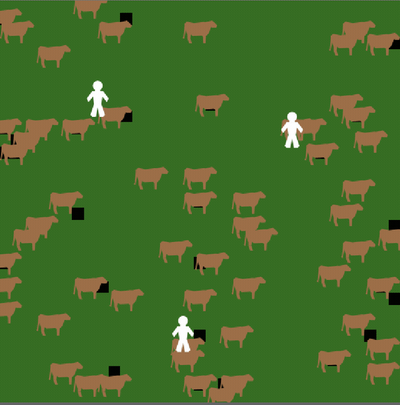
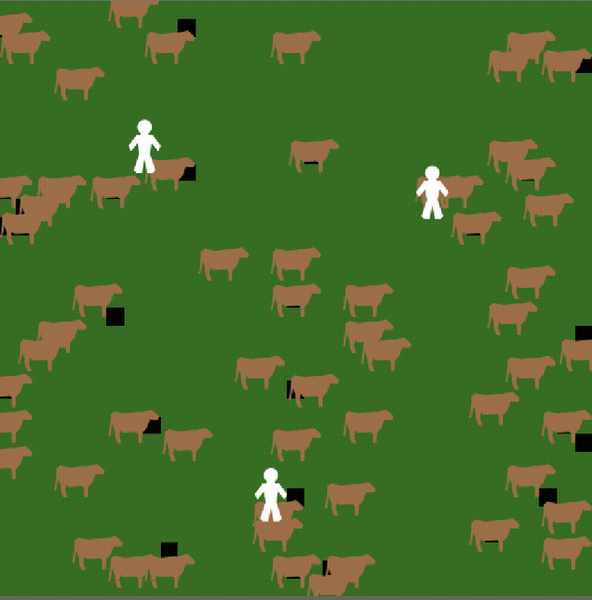
MASTOC-LLM extends the classic Multi-Agent System Tragedy of the Commons (MASTOC) model by replacing hard-coded behavioral rules with autonomous decision-making powered by large language models (LLMs). Three heterogeneous agents manage herds of cows on a shared grassland commons. Each tick, an agent receives a structured prompt describing current resource levels, its own herd size, peer behavior, and — optionally — a rolling memory of recent rounds and messages from neighboring agents. The LLM returns a stocking decision (add, remove, or hold cows) together with a natural-language rationale and, when communication is enabled, a short message to broadcast to peers.
The model is designed to test whether LLM agents spontaneously develop Ostrom-style common-pool resource governance (mutual monitoring, graduated sanctions, graduated rule revision) or instead fall into identifiable failure modes. Preliminary experiments with Claude Haiku 4.5, GPT-5.4-mini, and DeepSeek R1:32b have revealed four recurring collapse patterns — Cooperative Paralysis, Defection Cascade, Overshoot-Panic, and Hybrid Architecture Failure — whose onset timing is sensitive to memory length, inter-agent communication, and the post-training alignment approach of the underlying model.
MASTOC-LLM is intended as a laboratory for generative agent-based modelling (GABM) methodology: it provides a clean, well-understood commons baseline against which LLM behavioral hypotheses can be systematically tested and compared across models, parameter sweeps, and alignment regimes.
Release Notes
This release corrects a mathematical error in the baseline best-response decision rule, upgrades the batch sweep runner to support LLM conditions with cost estimation, and documents the first systematic psychosocial parameter sweep of the corrected baseline.
Associated Publications
MASTOC-LLM (Multi-Agent System Tragedy of the Commons - Large Language Models) 1.2.0
Submitted byThomas TuotiPublished May 19, 2026
Last modified May 19, 2026
MASTOC-LLM extends the classic Multi-Agent System Tragedy of the Commons (MASTOC) model by replacing hard-coded behavioral rules with autonomous decision-making powered by large language models (LLMs). Three heterogeneous agents manage herds of cows on a shared grassland commons. Each tick, an agent receives a structured prompt describing current resource levels, its own herd size, peer behavior, and — optionally — a rolling memory of recent rounds and messages from neighboring agents. The LLM returns a stocking decision (add, remove, or hold cows) together with a natural-language rationale and, when communication is enabled, a short message to broadcast to peers.
The model is designed to test whether LLM agents spontaneously develop Ostrom-style common-pool resource governance (mutual monitoring, graduated sanctions, graduated rule revision) or instead fall into identifiable failure modes. Preliminary experiments with Claude Haiku 4.5, GPT-5.4-mini, and DeepSeek R1:32b have revealed four recurring collapse patterns — Cooperative Paralysis, Defection Cascade, Overshoot-Panic, and Hybrid Architecture Failure — whose onset timing is sensitive to memory length, inter-agent communication, and the post-training alignment approach of the underlying model.
MASTOC-LLM is intended as a laboratory for generative agent-based modelling (GABM) methodology: it provides a clean, well-understood commons baseline against which LLM behavioral hypotheses can be systematically tested and compared across models, parameter sweeps, and alignment regimes.
Release Notes
This release corrects a mathematical error in the baseline best-response decision rule, upgrades the batch sweep runner to support LLM conditions with cost estimation, and documents the first systematic psychosocial parameter sweep of the corrected baseline.
Julia Schindler (2013, April 27). “MASTOC - A Multi-Agent System of the Tragedy Of The Commons” (Version 1.1.0). CoMSES Computational Model Library. Retrieved from: https://www.comses.net/codebases/2283/releases/1.1.0/
Create an Open Code Badge that links to this model more info
This model has not been reviewed by CoMSES Net and should be independently reviewed to
meet the Open Code Badge guidelines.
You can use the following HTML or Markdown code to create an Open Code Badge that links to
version 1.2.0
of this computational model.
This website uses cookies and Google Analytics to help us track user engagement and improve our site. If
you'd like to know more information about what data we collect and why, please see
our data privacy policy. If you continue to use this site, you consent to
our use of cookies.