Our mission is to help computational modelers develop, document, and share their computational models in accordance with community standards and good open science and software engineering practices. Model authors can publish their model source code in the Computational Model Library with narrative documentation as well as metadata that supports open science and emerging norms that facilitate software citation, computational reproducibility / frictionless reuse, and interoperability. Model authors can also request private peer review of their computational models. Models that pass peer review receive a DOI once published.
All users of models published in the library must cite model authors when they use and benefit from their code.
Please check out our model publishing tutorial and feel free to contact us if you have any questions or concerns about publishing your model(s) in the Computational Model Library.
Displaying 10 of 108 results for "Josh T Bazuin" clear search
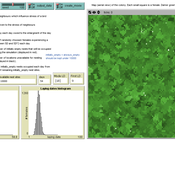
A modified model of breeding synchrony in colonial birds
James Millington | Published Tuesday, June 26, 2012 | Last modified Saturday, April 27, 2013This generic individual-based model of a bird colony shows how the influence neighbour’s stress levels synchronize the laying date of neighbours and also of large colonies. The model has been used to demonstrate how this form of simulation model can be recognised as being ‘event-driven’, retaining a history in the patterns produced via simulated events and interactions.
Cooperation Under Resources Pressure (CURP)
María Pereda José Manuel Galán Ordax José Santos | Published Monday, November 21, 2016 | Last modified Wednesday, April 25, 2018This is an agent-based model designed to explore the evolution of cooperation under changes in resources availability for a given population
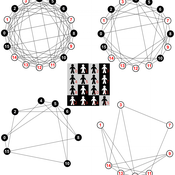
Mesoscopic Effects in an Agent-Based Bargaining Model in Regular Lattices
David Poza José Manuel Galán Ordax José Santos Adolfo López-Paredes | Published Thursday, February 02, 2017 | Last modified Wednesday, April 25, 2018We propose an agent-based model where a fixed finite population of tagged agents play iteratively the Nash demand game in a regular lattice. The model extends the bargaining model by Axtell, Epstein and Young.
Industrial Cooperation and the Hydrogen Transition
Amineh Ghorbani Renske van 't Veer Emre Ates Zofia Lukszo | Published Tuesday, September 23, 2025An Agent Based Model that explores the deployment of hydrogen among a regional industrial cluster in the Netherlands, consisting of 15 companies. The companies seek to decarbonize by replacing their natural gas by hydrogen.
The model integrates technical characteristics as well as company motivations to transition to hydrogen. The baseline model only considers individual investments where company can locally produce hydrogen. If they reach the backbone threshold, companies can also consider buying hydrogen through a connection to the national hydrogen network. The second scenario considers that companies can participate in a joint investment to get an electrolyzer to locally produce the hydrogen.
Two experiments look at the impact of the sectoral configuration and at the impact of subsidy conditions on the region’s hydrogen transition
An Agent-Based Model of Saving under Quasi-Hyperbolic Discounting on a Social Network.
Jose Alejandro Velazquez Monzon | Published Wednesday, June 24, 2026An agent-based model of saving and dissaving behaviour under quasi-hyperbolic (β–δ) discounting. Building on the individual decision problem of Cao and Werning (2018), the model embeds present-biased agents in a Watts–Strogatz small-world network and adds three configurable mechanisms of social influence — information diffusion, peer comparison, and social-norm conformity — across five heterogeneous behavioural profiles (Planners, Moderates, Procrastinators, Inverse Procrastinators, and Impulsive agents).
Each profile’s saving policy is approximated by value-function iteration over a discretised wealth grid; the solved policies are cached and applied as agents interact over their network neighbourhoods. The model tests whether each social mechanism can alter the saving and wealth trajectories that present-biased agents would otherwise follow in isolation, and characterises the direction and size of each effect on median wealth, wealth inequality (Gini), and the incidence of severely depleted agents.
The deposit includes the core model (Model.py), an analysis and visualisation pipeline (analyze_results.py), a standalone ODD description (ODD.md), and pinned dependencies.
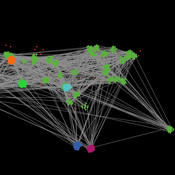
Peer reviewed Hohokam Trade Networks Model
Joshua Watts | Published Sunday, October 26, 2014The Hohokam Trade Networks Model focuses on key features of the Hohokam economy to explore how differences in trade network topologies may show up in the archaeological record. The model is set in the Phoenix Basin of central Arizona, AD 200-1450.
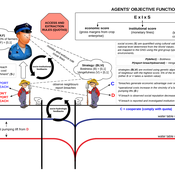
The Groundwater Commons Game
Juan Castilla-Rho Rodrigo Rojas | Published Thursday, May 11, 2017 | Last modified Saturday, September 16, 2017The Groundwater Commons Game synthesises and extends existing work on human cooperation and collective action, to elucidate possible determinants and pathways to regulatory compliance in groundwater systems globally.
The SAFIRe model : Simulation of Agents for Fertility, Integrated Energy, Food security, and Reforestation
Etienne DELAY Lucas Broutin | Published Thursday, June 12, 2025The SAFIRe model (Simulation of Agents for Fertility, Integrated Energy, Food Security, and Reforestation) is an agent-based model co-developed with rural communities in Senegal’s Groundnut Basin. Its purpose is to explore how local farming and pastoral practices affect the regeneration of Faidherbia albida trees, which are essential for maintaining soil fertility and supporting food security through improved millet production. The model supports collective reflection on how different social and ecological factors interact, particularly around firewood demand, livestock pressure, and agricultural intensification.
The model simulates a 100-hectare agricultural landscape where agents (farmers, shepherds, woodcutters, and supervisors) interact with trees, land parcels, and each other. It incorporates seasonality, crop rotation, tree growth and cutting, livestock feeding behaviors, and farmers’ engagement in sapling protection through Assisted Natural Regeneration (ANR). Two types of surveillance strategies are compared: community-led monitoring and delegated surveillance by forestry authorities. Farmer engagement evolves over time based on peer influence, meeting participation, and the success of visible tree regeneration efforts.
SAFIRe integrates participatory modeling (ComMod and ComExp) and a backcasting approach (ACARDI) to co-produce scenarios rooted in local aspirations. It was explored using the OpenMole platform, allowing stakeholders to test a wide range of future trajectories and analyze the sensitivity of key parameters (e.g., discussion frequency, time in fields). The model’s outcomes not only revealed unexpected insights—such as the hidden role of farmers in tree loss—but also led to real-world actions, including community nursery creation and behavioral shifts toward tree care. SAFIRe illustrates how agent-based modeling can become a tool for social learning and collective action in socio-ecological systems.
Cooling in simulated annealing using Metropolis' algorithm (version a & b)
María Pereda José Santos José Manuel Galán Virginia Ahedo | Published Monday, March 15, 2021Netlogo model that shows how the cooling process determines the quality of a solution in simulated annealing using Metropolis algorithm.
Wave When the Hale Wale (WWHW)
María Pereda José Manuel Galán Iván Briz I Godino Jorge Caro Débora Zurro Myriam Álvarez José Santos | Published Friday, October 10, 2014 | Last modified Wednesday, April 25, 2018WWHW is an agent-based model designed to allow the exploration of the emergence, resilience and evolution of cooperative behaviours in hunter-fisher-gatherer societies.
Displaying 10 of 108 results for "Josh T Bazuin" clear search