Our mission is to help computational modelers develop, document, and share their computational models in accordance with community standards and good open science and software engineering practices. Model authors can publish their model source code in the Computational Model Library with narrative documentation as well as metadata that supports open science and emerging norms that facilitate software citation, computational reproducibility / frictionless reuse, and interoperability. Model authors can also request private peer review of their computational models. Models that pass peer review receive a DOI once published.
All users of models published in the library must cite model authors when they use and benefit from their code.
Please check out our model publishing tutorial and feel free to contact us if you have any questions or concerns about publishing your model(s) in the Computational Model Library.
Displaying 10 of 67 results for "Harry Peter Andreassen" clear search
Last Mile Commuter Behavior Model
Dean Massey Moira Zellner Yoram Shiftan Jonathan Levine Maria Arquero | Published Friday, November 07, 2014 | Last modified Friday, November 07, 2014We represent commuters and their preferences for transportation cost, time and safety. Agents assess their options via their preferences, their environment, and the modes available. The model has policy levers to test impact on last-mile problem.
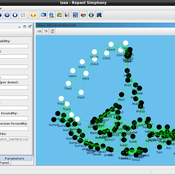
Modeling Asian-Papuan Admixture during the Neolithic Expansion across Island Southeast Asia
Murray Cox François Vallée | Published Friday, December 09, 2016This Repast Simphony model simulates genomic admixture during the farming expansion of human groups from mainland Asia into the Papuan dominated islands of Southeast Asia during the Neolithic period.
Coalitions in Networked Innovation
Rory Sie Peter Sloep Marlies Bitter-Rijpkema | Published Tuesday, February 11, 2014A first version of a model that describes how coalitions are formed during open, networked innovation
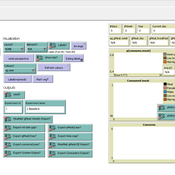
An agent-based model to simulate meat consumption behaviour of consumers in Britain
Andrea Scalco | Published Friday, October 18, 2019The current rate of production and consumption of meat poses a problem both to peoples’ health and to the environment. This work aims to develop a simulation of peoples’ meat consumption behaviour in Britain using agent-based modelling. The agents represent individual consumers. The key variables that characterise agents include sex, age, monthly income, perception of the living cost, and concerns about the impact of meat on the environment, health, and animal welfare. A process of peer influence is modelled with respect to the agents’ concerns. Influence spreads across two eating networks (i.e. co-workers and household members) depending on the time of day, day of the week, and agents’ employment status. Data from a representative sample of British consumers is used to empirically ground the model. Different experiments are run simulating interventions of application of social marketing campaigns and a rise in price of meat. The main outcome is the average weekly consumption of meat per consumer. A secondary outcome is the likelihood of eating meat.
An Agent-Based Model of Saving under Quasi-Hyperbolic Discounting on a Social Network.
Jose Alejandro Velazquez Monzon | Published Wednesday, June 24, 2026An agent-based model of saving and dissaving behaviour under quasi-hyperbolic (β–δ) discounting. Building on the individual decision problem of Cao and Werning (2018), the model embeds present-biased agents in a Watts–Strogatz small-world network and adds three configurable mechanisms of social influence — information diffusion, peer comparison, and social-norm conformity — across five heterogeneous behavioural profiles (Planners, Moderates, Procrastinators, Inverse Procrastinators, and Impulsive agents).
Each profile’s saving policy is approximated by value-function iteration over a discretised wealth grid; the solved policies are cached and applied as agents interact over their network neighbourhoods. The model tests whether each social mechanism can alter the saving and wealth trajectories that present-biased agents would otherwise follow in isolation, and characterises the direction and size of each effect on median wealth, wealth inequality (Gini), and the incidence of severely depleted agents.
The deposit includes the core model (Model.py), an analysis and visualisation pipeline (analyze_results.py), a standalone ODD description (ODD.md), and pinned dependencies.
SimAdapt
François Rebaudo | Published Wednesday, August 29, 2012 | Last modified Monday, October 13, 2014SimAdapt: An individual-based genetic model for simulating landscape management impacts on populations
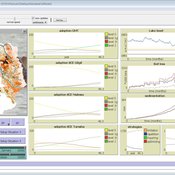
CONSERVAT
Pieter Van Oel | Published Monday, April 13, 2015The CONSERVAT model evaluates the effect of social influence among farmers in the Lake Naivasha basin (Kenya) on the spatiotemporal diffusion pattern of soil conservation effort levels and the resulting reduction in lake sedimentation.
A Simulation of Entrepreneurial Spawning
Mark Bagley | Published Wednesday, June 08, 2016 | Last modified Friday, June 30, 2017Industrial clustering patterns are the result of an entrepreneurial process where spinoffs inherit the ideas and attributes of their parent firms. This computational model maps these patterns using abstract methodologies.
Peer reviewed Multilevel Group Selection I
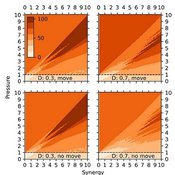
Wayne W. Wakeland Thaddeus Shannon Garry Sotnik | Published Tuesday, April 21, 2020 | Last modified Saturday, July 03, 2021New theoretical agent-based model of population-wide adoption of prosocial common-pool behavior with four parameters (initial percent of adopters, pressure to change behavior, synergy from behavior, and population density); dynamics in behavior, movement, freeriding, and group composition and size; and emergence of multilevel group selection. Theoretical analysis of model’s dynamics identified six regions in model’s parameter space, in which pressure-synergy combinations lead to different outcomes: extinction, persistence, and full adoption. Simulation results verified the theoretical analysis and demonstrated that increases in density reduce number of pressure-synergy combinations leading to population-wide adoption; initial percent of contributors affects underlying behavior and final outcomes, but not size of regions or transition zones between them; and random movement assists adoption of prosocial common-pool behavior.

Peer reviewed Descriptive Norm and Fraud Dynamics
Alexandra Eckert Matthias Meyer Christian Stindt | Published Tuesday, January 07, 2025 | Last modified Tuesday, March 24, 2026The “Descriptive Norm and Fraud Dynamics” model demonstrates how fraudulent behavior can either proliferate or be contained within non-hierarchical organizations, such as peer networks, through social influence taking the form of a descriptive norm. This model expands on the fraud triangle theory, which posits that an individual must concurrently possess a financial motive, perceive an opportunity, and hold a pro-fraud attitude to engage in fraudulent activities (red agent). In the absence of any of these elements, the individual will act honestly (green agent).
The model explores variations in a descriptive norm mechanism, ranging from local distorted knowledge to global perfect knowledge. In the case of local distorted knowledge, agents primarily rely on information from their first-degree colleagues. This knowledge is often distorted because agents are slow to update their empirical expectations, which are only partially revised after one-to-one interactions. On the other end of the spectrum, local perfect knowledge is achieved by incorporating a secondary source of information into the agents’ decision-making process. Here, accurate information provided by an observer is used to update empirical expectations.
The model shows that the same variation of the descriptive norm mechanism could lead to varying aggregate fraud levels across different fraud categories. Two empirically measured norm sensitivity distributions associated with different fraud categories can be selected into the model to see the different aggregate outcomes.
Displaying 10 of 67 results for "Harry Peter Andreassen" clear search