Our mission is to help computational modelers develop, document, and share their computational models in accordance with community standards and good open science and software engineering practices. Model authors can publish their model source code in the Computational Model Library with narrative documentation as well as metadata that supports open science and emerging norms that facilitate software citation, computational reproducibility / frictionless reuse, and interoperability. Model authors can also request private peer review of their computational models. Models that pass peer review receive a DOI once published.
All users of models published in the library must cite model authors when they use and benefit from their code.
Please check out our model publishing tutorial and feel free to contact us if you have any questions or concerns about publishing your model(s) in the Computational Model Library.
Displaying 10 of 83 results for "Yaman Barlas" clear search
Evaluating Government's Policies on Promoting Smart Metering Diffusion in Retail Electricity Markets
Tao Zhang | Published Monday, December 07, 2009 | Last modified Saturday, April 27, 2013This model is a market game for evaluating the effectiveness of the UK government’s 2008-2010 policy on promoting smart metering in the UK retail electricity market. We break down the policy into four
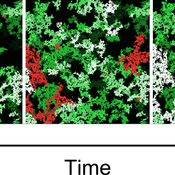
Feedback Loop Example: Wildland Fire Spread
James Millington | Published Friday, December 21, 2012 | Last modified Saturday, April 27, 2013This model is a replication of that described by Peterson (2002) and illustrates the ‘spread’ feedback loop type described in Millington (2013).
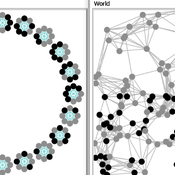
Two agent-based models of cooperation in dynamic groups and fixed social networks
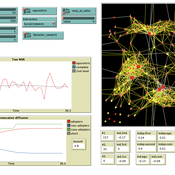
Carlos A. de Matos Fernandes | Published Thursday, January 20, 2022Both models simulate n-person prisoner dilemma in groups (left figure) where agents decide to C/D – using a stochastic threshold algorithm with reinforcement learning components. We model fixed (single group ABM) and dynamic groups (bad-barrels ABM). The purpose of the bad-barrels model is to assess the impact of information during meritocratic matching. In the bad-barrels model, we incorporated a multidimensional structure in which agents are also embedded in a social network (2-person PD). We modeled a random and homophilous network via a random spatial graph algorithm (right figure).
Recycling behavior of Chinese households
Igor Nikolic B Dijkhuizen M Van Den Hoven M Minderhoud N Wäckerlin | Published Monday, June 19, 2017 | Last modified Thursday, March 29, 2018The model represents empirically observed recycling behaviour of Chinese citizens, based on the theory of reasoned action (TRA), the theory of planned behaviour (TPB) and the theory of planned behaviour extended with situational factors (TPB+).
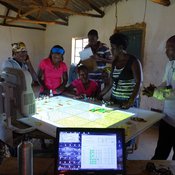
Kulayinjana
Christophe Le Page Arthur Perrotton Michel De Garine-Wichatitsky Barry Bitu Killion Koyisi Ferdinand Mwamba Cephus Ncube Victor Ncube Siphusisiwe Ndlovu Raphael Ngwenya Ambu Nyathi Fumbane Nyathi Patrick Sibanda Zenzo Sibanda | Published Monday, October 03, 2016a computer-based role-playing game simulating the interactions between farming activities, livestock herding and wildlife in a virtual landscape reproducing local socioecological dynamics at the periphery of Hwange National Park (Zimbabwe).
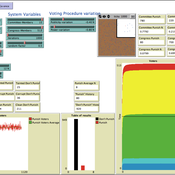
Sunshine or Shield?: Secret Voting Procedures and Legislative Accountability
Matthew Taylor Michele Buttò Carlos Pereira | Published Tuesday, June 24, 2014 | Last modified Monday, April 08, 2019An agent-based model is used to simulate legislators’ behavior under secret voting rules, as influenced by the power of the accused politician, the composition of the voting body, and the publicity of the accusations.
MCR Model
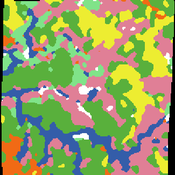
Davide Secchi Nuno R Barros De Oliveira | Published Friday, July 22, 2016 | Last modified Saturday, January 23, 2021The aim of the model is to define when researcher’s assumptions of dependence or independence of cases in multiple case study research affect the results — hence, the understanding of these cases.
Resource distribution effects on optimal foraging theory
Marco Janssen Kim Hill | Published Friday, January 27, 2017The original Ache model is used to explore different distributions of resources on the landscape and it’s effect on optimal strategies of the camps on hunting and camp movement.
ABSAM model
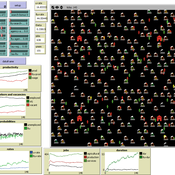
Marcin Wozniak | Published Monday, August 29, 2016 | Last modified Tuesday, November 08, 2016ABSAM model is an agent-based search and matching model of the local labor market. There are four types of agents in the economy, which cooperate in the artificial world, where behavioral rules were extracted from the labor market search theory.
Peer reviewed The OctoPINTS Model: Compliance and periodic fisheries closures (Beta)
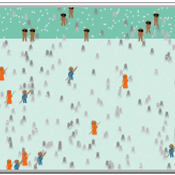
Emilie Lindkvist Maja Schlüter Tim M Daw Elizabeth Drury O'Neill Benedetta Veneroni Jineth Berrío-Martínez | Published Wednesday, April 20, 2022The purpose of the model is to explore how processes associated with compliance across different fishery actors’ social groups interplay with their acceptance of a fishery intervention, herein periodic closures of a small-scale octopus fishery. The model agents, entities and processes are designed based on stylized facts from literature and expert workshops on periodic closures in the Western Indian Ocean region, as well as fieldwork from Zanzibari villages that have implemented periodic octopus closures. The model is designed for scientists and decision-makers that are interested in understanding the complex interplay between fishers from different social groups, herein foot fisher men, foot fisher women and male skin divers or free divers within the periodic closure of an octopus species. Including various actions resulting from the restrictions, that is - opportunities that may be presented from restricting fishing in certain areas and during certain times. We are soon publishing an updated model with individual octopuses and their movement behaviors.
Displaying 10 of 83 results for "Yaman Barlas" clear search