Our mission is to help computational modelers develop, document, and share their computational models in accordance with community standards and good open science and software engineering practices. Model authors can publish their model source code in the Computational Model Library with narrative documentation as well as metadata that supports open science and emerging norms that facilitate software citation, computational reproducibility / frictionless reuse, and interoperability. Model authors can also request private peer review of their computational models. Models that pass peer review receive a DOI once published.
All users of models published in the library must cite model authors when they use and benefit from their code.
Please check out our model publishing tutorial and feel free to contact us if you have any questions or concerns about publishing your model(s) in the Computational Model Library.
Displaying 10 of 1156 results for "Elena A. Pearce" clear search
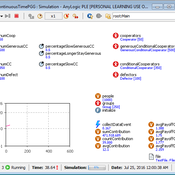
An Agent-Based Simulation of Continuous-Time Public Goods Games
Tuong Manh Vu | Published Thursday, May 17, 2018 | Last modified Tuesday, April 02, 2019To our knowledge, this is the first agent-based simulation of continuous-time PGGs (where participants can change contributions at any time) which are much harder to realise within both laboratory and simulation environments.
Work related to this simulation has been published in the following journal article:
Vu, Tuong Manh, Wagner, Christian and Siebers, Peer-Olaf (2019) ‘ABOOMS: Overcoming the Hurdles of Continuous-Time Public Goods Games with a Simulation-Based Approach’ Journal of Artificial Societies and Social Simulation 22 (2) 7 http://jasss.soc.surrey.ac.uk/22/2/7.html. doi: 10.18564/jasss.3995
Abstract:
…
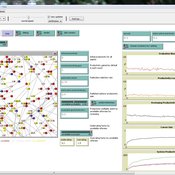
Peer Review Model
Flaminio Squazzoni Claudio Gandelli | Published Wednesday, September 05, 2012 | Last modified Saturday, April 27, 2013This model looks at implications of author/referee interaction for quality and efficiency of peer review. It allows to investigate the importance of various reciprocity motives to ensure cooperation. Peer review is modelled as a process based on knowledge asymmetries and subject to evaluation bias. The model includes various simulation scenarios to test different interaction conditions and author and referee behaviour and various indexes that measure quality and efficiency of evaluation […]
An agent-based model to study the effects of trust in coalition formation
Luis Gustavo Nardin | Published Wednesday, August 31, 2011 | Last modified Saturday, April 27, 2013This model is an agent-based simulation that consists of agents who play the spatial prisioner’s dilemma game with coalition formation. The coalition dynamics are mainly influenced by how much the agents trust their leaders. The main objective is provide a simulation model to enable the analysis of the impacts that the use of trust may cause in coalition formation.
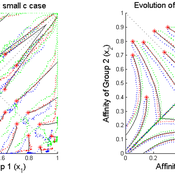
Affinity/Hostility in Divided Communities
Christopher Thron | Published Friday, January 22, 2016Agent-based model of intergroup conflict in divided communities.
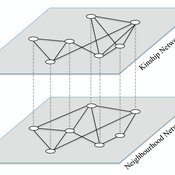
Diffusion of Innovations on Social Networks
Hang Xiong | Published Saturday, April 16, 2016This is model that simulates how multiple kinds of peer effects shape the diffusion of innovations through different types of social relationships.
Tiebout sorting
Marco Janssen | Published Thursday, January 24, 2019This Netlogo replication of Kollman, K., J.H. Miller and S.E. Page (1997) Political Institutions and Sorting in a Tiebout Model, American Economic Review 87(5): 977-992. The model consists of of citizens who can vote for partie and move to other jurisdictions if they expect their preferences are better served. Parties adjust their positions to increase their share in the elections.
Parallel trading systems
Marcin Czupryna | Published Friday, June 26, 2020The model simulates agents behaviour in wine market parallel trading systems: auctions, OTC and Liv-ex. Models are written in JAVA and use MASON framework. To run a simulation download source files with additional src folder with sobol.csv file. In WineSimulation.java set RESULTS_FOLDER parameter. Uses following external libraries mason19..jar, opencsv.jar, commons-lang3-3.5.jar and commons-math3-3.6.1.jar.
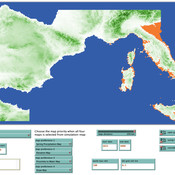
Geographic Expansion Model (GEM)
Sean Bergin | Published Friday, February 28, 2020The purpose of this model is to explore the importance of geographic factors to the settlement choices of early Neolithic agriculturalists. In the model, each agriculturalist spreads to one of the best locations within a modeler specified radius. The best location is determined by choosing either one factor such as elevation or slope; or by ranking geographic factors in order of importance.
The NetLogo HIV Spread Model Exploring Impact of PrEP Indication Guidelines
Uri Wilensky Wouter Vermeer Arthur Hjorth | Published Friday, June 05, 2020This agent-based model was built as part of a replication effort of Jeness et al.’s work (linked below). The model simulates an MSM sexual activity network for the purpose of modeling the effects of respectively PrEP and ART on HIV prevention. The purpose of the model is to explore the differences between differerent interpretations of the NIH Indication Guidelines for PrEP.
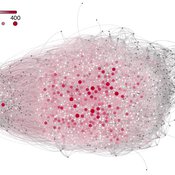
Dynamics of Public Opinion with Diverse Media and Audiences' Choice
Zhongtian Chen | Published Sunday, April 25, 2021Studies on the fundamental role of diverse media in the evolution of public opinion can protect us from the spreading brainwashing, extremism, and terrorism. Many fear the information cocoon may result in polarization of the public opinion. The model of opinion dynamics that considers different influences and horizons for every individual, and the simulations are based on a real-world social network.
Displaying 10 of 1156 results for "Elena A. Pearce" clear search