Computational Model Library

Spatial Game Theory (1.0.0)

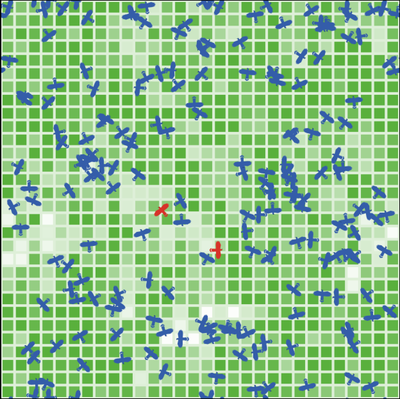
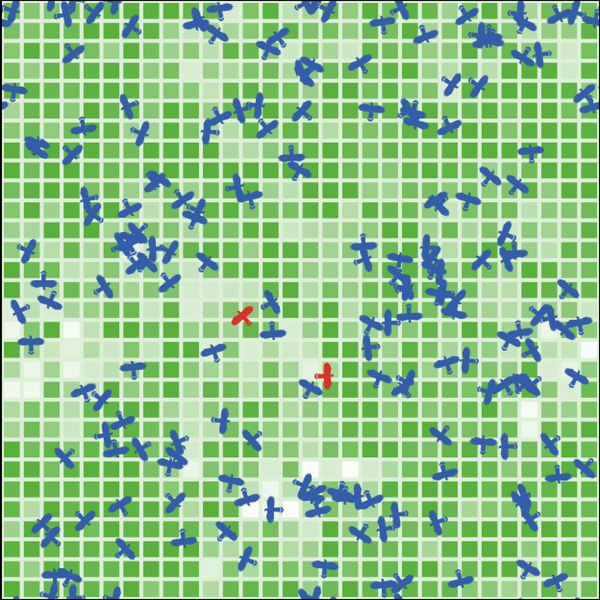
This model is a spatial evolutionary game theory model in which animals with inherited red or blue phenotypes move, interact locally, gain or lose energy based on payoff structure, and reproduce across generations. Plants provide a stationary green component of the environment. The model can be used to examine how game payoffs, inheritance, and survival shape population and evolutionary dynamics over time.
HawkDoveGame-view-1.png

Release Notes

This release introduces a spatial evolutionary game theory model in which animals with inherited red and blue phenotypes move through space, interact locally, gain or lose energy based on payoff structure, and reproduce across generations. Plants were included as stationary green agents that occupy the landscape and contribute an environmental component to local interactions.

Core model behavior now includes energy-based movement, local game interactions, phenotype-dependent reproduction, parenting costs, and survival costs. Offspring inherit alleles from both parents, allowing phenotype frequencies to change over time through differential survival and reproduction. The model therefore links local interaction outcomes to evolutionary change.

This version also includes plant energy regrowth, phenotype updating, generation tracking, offspring counts, and explicit scheduling of movement, interaction, reproduction, survival, and state updating within each tick. Overall, the model now provides a basic framework for exploring how payoff structure, inheritance, and demographic costs shape evolutionary dynamics in a spatial setting.

Associated Publications

Spatial Game Theory 1.0.0

This model is a spatial evolutionary game theory model in which animals with inherited red or blue phenotypes move, interact locally, gain or lose energy based on payoff structure, and reproduce across generations. Plants provide a stationary green component of the environment. The model can be used to examine how game payoffs, inheritance, and survival shape population and evolutionary dynamics over time.

Release Notes

This release introduces a spatial evolutionary game theory model in which animals with inherited red and blue phenotypes move through space, interact locally, gain or lose energy based on payoff structure, and reproduce across generations. Plants were included as stationary green agents that occupy the landscape and contribute an environmental component to local interactions.

Core model behavior now includes energy-based movement, local game interactions, phenotype-dependent reproduction, parenting costs, and survival costs. Offspring inherit alleles from both parents, allowing phenotype frequencies to change over time through differential survival and reproduction. The model therefore links local interaction outcomes to evolutionary change.

This version also includes plant energy regrowth, phenotype updating, generation tracking, offspring counts, and explicit scheduling of movement, interaction, reproduction, survival, and state updating within each tick. Overall, the model now provides a basic framework for exploring how payoff structure, inheritance, and demographic costs shape evolutionary dynamics in a spatial setting.

Version Submitter First published Last modified Status
1.0.0 Kristin Crouse Tue Nov 5 04:51:09 2019 Mon Apr 20 09:33:08 2026 Published

Discussion

This website uses cookies and Google Analytics to help us track user engagement and improve our site. If you'd like to know more information about what data we collect and why, please see our data privacy policy. If you continue to use this site, you consent to our use of cookies.
Accept