Our mission is to help computational modelers develop, document, and share their computational models in accordance with community standards and good open science and software engineering practices. Model authors can publish their model source code in the Computational Model Library with narrative documentation as well as metadata that supports open science and emerging norms that facilitate software citation, computational reproducibility / frictionless reuse, and interoperability. Model authors can also request private peer review of their computational models. Models that pass peer review receive a DOI once published.
All users of models published in the library must cite model authors when they use and benefit from their code.
Please check out our model publishing tutorial and feel free to contact us if you have any questions or concerns about publishing your model(s) in the Computational Model Library.
Displaying 1 of 1 results hawk-dove game clear search
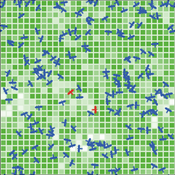
Spatial Game Theory
Kristin Crouse | Published Tuesday, November 05, 2019 | Last modified Wednesday, April 22, 2026This model is a spatial evolutionary game theory model in which animals with inherited red or blue phenotypes move, interact locally, gain or lose energy based on payoff structure, and reproduce across generations. Plants provide a stationary green component of the environment. The model can be used to examine how game payoffs, inheritance, and survival shape population and evolutionary dynamics over time.