Our mission is to help computational modelers develop, document, and share their computational models in accordance with community standards and good open science and software engineering practices. Model authors can publish their model source code in the Computational Model Library with narrative documentation as well as metadata that supports open science and emerging norms that facilitate software citation, computational reproducibility / frictionless reuse, and interoperability. Model authors can also request private peer review of their computational models. Models that pass peer review receive a DOI once published.
All users of models published in the library must cite model authors when they use and benefit from their code.
Please check out our model publishing tutorial and feel free to contact us if you have any questions or concerns about publishing your model(s) in the Computational Model Library.
Displaying 10 of 221 results for "Martin Takáč" clear search
Genetic Algorithm and Food Choice
Diego Martín Díaz Córdova | Published Monday, August 10, 2026This models simulate how people choose their food buyings based on a limited budget and a food quality index. In order to make the choice the agents call a genetic algorithm who optimizes the buying. The agents are distributed randomly and there are 5 store options where agents can buy meat, fruits and vegetables, bread, ultraprocessed and medications. Agents need all of them, each of one has a different price and a different quality index. The genetic algorithm perform an optimization procedure in order to clasiffy what food set is the best for each agent. The agents are coloured based on their budget if the’ve got less than 100, then they are pink otherwise they are white.
Peer reviewed lgm_ecodynamics
Colin Wren | Published Monday, April 22, 2019This is a modification of a model published previous by Barton and Riel-Salvatore (2012). In this model, we simulate six regional populations within Last Glacial Maximum western Europe. Agents interact through reproduction and genetic markers attached to each of six regions mix through subsequent generations as a way to track population dynamics, mobility, and gene flow. In addition, the landscape is heterogeneous and affects agent mobility and, under certain scenarios, their odds of survival.
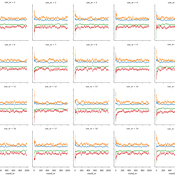
Peer reviewed Dynamic Equilibria Prediction: Experience-Weighted Attraction (EWA), Python Implementation
Vinicius Ferraz | Published Friday, December 02, 2022This project is based on a Jupyter Notebook that describes the stepwise implementation of the EWA model in bi-matrix ( 2×2 ) strategic-form games for the simulation of economic learning processes. The output is a dataset with the simulated values of Attractions, Experience, selected strategies, and payoffs gained for the desired number of rounds and periods. The notebook also includes exploratory data analysis over the simulated output based on equilibrium, strategy frequencies, and payoffs.
ABM Code: Locating Cultural Holes Brokers in Diffusion Dynamics across Bright Symbolic Boundaries
Diego Leal | Published Thursday, January 23, 2025The code and data in this repository are associated with the article titled:
Leal, Diego F. 2025. “Locating Cultural Holes Brokers in Diffusion Dynamics across Bright Symbolic Boundaries.” Sociological Methods & Research OnlineFirst https://doi.org/10.1177/00491241251322517
The NetLogo code (version 6.4.0) is designed to be a standalone piece of code although it uses the ‘nw’ and ‘matrix’ extensions that come integrated with NetLogo 6.4.0. The code was ran on a Windows 10 x 64 machine.
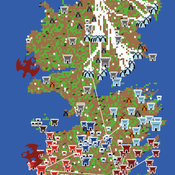
Game of Thrones model
Sean Bergin Claudine Gravel-Miguel | Published Sunday, January 03, 2021 | Last modified Sunday, January 03, 2021This model slowly evolves to become Westeros, with houses fighting for the thrones, and whitewalkers trying to kill all living things. You can download each version to see the evolution of the code, from the Wolf Sheep Predation model to the Game of Thrones model. If you are only interested in the end product, simply download the latest version.
For instructions on each step, see: https://claudinegravelmigu.wixsite.com/got-abm
Peer reviewed Routes & Rumours 0.1.1
Jakub Bijak Martin Hinsch Oliver Reinhardt | Published Tuesday, July 12, 2022Routes & Rumours is an agent-based model of (forced) human migration. We model the formation of migration routes under the assumption that migrants have limited geographical knowledge concerning the transit area and rely to a large degree on information obtained from other migrants.
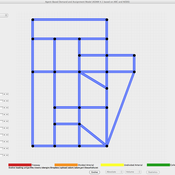
ADAM: Agent-based Demand and Assignment Model
D Levinson | Published Monday, August 29, 2011 | Last modified Saturday, April 27, 2013The core algorithm is an agent-based model, which simulates travel patterns on a network based on microscopic decision-making by each traveler.
MASTOC - A Multi-Agent System of the Tragedy Of The Commons
Julia Schindler | Published Tuesday, November 30, 2010 | Last modified Saturday, April 27, 2013MASTOC is a replication of the Tragedy of the Commons by G. Hardin, programmed in NetLogo 4.0.4, based on behavioral game theory and Nash solution.
Peer reviewed Green Consumption Tipping Point
Mario | Published Thursday, February 26, 2026This model is a minimal agent-based model (ABM) of green consumption and market tipping dynamics in a stylised two-firm economy. It is designed as an existence proof to illustrate how weak individual preferences, when combined with habit formation, social influence, and firm price adaptation, can generate non-linear transitions (tipping points) in market outcomes.
The economy consists of:
1) Two firms, each supplying a differentiated consumption bundle that differs in its fixed green share (one relatively greener, one less green).
2) Many households, each consuming a unit mass per period and allocating consumption between the two firms.
…
Introductory SIR Model
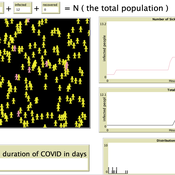
Kit Martin Amber Cesare Matthew Johnson | Published Tuesday, September 28, 2021This is a basic Susceptible, Infected, Recovered (SIR) model. This model explores the spread of disease in a space. In particular, it explores how changing assumptions about the number of susceptible people, starting number of infected people, as well as the disease’s infection probability, and average duration of infection. The model shows that the interactions of agents can drastically affect the results of the model.
We used it in our course on COVID-19: https://www.csats.psu.edu/science-of-covid19
Displaying 10 of 221 results for "Martin Takáč" clear search