Our mission is to help computational modelers develop, document, and share their computational models in accordance with community standards and good open science and software engineering practices. Model authors can publish their model source code in the Computational Model Library with narrative documentation as well as metadata that supports open science and emerging norms that facilitate software citation, computational reproducibility / frictionless reuse, and interoperability. Model authors can also request private peer review of their computational models. Models that pass peer review receive a DOI once published.
All users of models published in the library must cite model authors when they use and benefit from their code.
Please check out our model publishing tutorial and feel free to contact us if you have any questions or concerns about publishing your model(s) in the Computational Model Library.
Displaying 10 of 554 results for "Viet Cao" clear search
Replication of ECEC model: Environmental Feedback and the Evolution of Cooperation
Pierre Bommel | Published Tuesday, April 05, 2011 | Last modified Saturday, April 27, 2013The model, presented here, is a re-implementation of the Pepper and Smuts’ model : - Pepper, J.W. and B.B. Smuts. 2000. “The evolution of cooperation in an ecological context: an agent-based model”. Pp. 45-76 in T.A. Kohler and G.J. Gumerman, eds. Dynamics of human and primate societies: agent-based modeling of social and spatial processes. Oxford University Press, Oxford. - Pepper, J.W. and B.B. Smuts. 2002. “Assortment through Environmental Feedback”. American Naturalist, 160: 205-213 […]
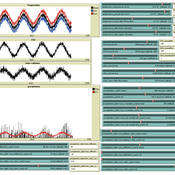
Peer reviewed The Indus Village's Weather model: procedural generation of daily weather
Andreas Angourakis | Published Tuesday, May 13, 2025Overview
The Weather model is a procedural generation model designed to create realistic daily weather data for socioecological simulations. It generates synthetic weather time series for solar radiation, temperature, and precipitation using algorithms based on sinusoidal and double logistic functions. The model incorporates stochastic variation to mimic unpredictable weather patterns and aims to provide realistic yet flexible weather inputs for exploring diverse climate scenarios.
The Weather model can be used independently or integrated into larger models, providing realistic weather patterns without extensive coding or data collection. It can be customized to meet specific requirements, enabling users to gain a better understanding of the underlying mechanisms and have greater confidence in their applications.
…
Nudging agents in social networks for collective action
Marco Janssen | Published Sunday, August 14, 2011 | Last modified Sunday, March 17, 2019Agents are linked in a social-network and make decisions on which of 2 types of behavior to adopt. We explore consequences of different information feedback and providing targeted feedback to individuals.
A simple Multi-Agent System of the Tragedy Of the Commons (MASTOC-s)
Julia Schindler | Published Friday, June 29, 2012 | Last modified Saturday, April 27, 2013This is a simple model replicating Hardin’s Tragedy of the Commons using reactive agents that have psychological behavioral and social preferences.
Hominin Ecodynamics v.1.1 (update for perception and interaction)
C Michael Barton | Published Wednesday, August 15, 2012 | Last modified Saturday, April 27, 2013Models land-use, perception, and biocultural interactions between two forager populations.
The MOBILITY model analyzes how agents’ mobility affects the performance of social-ecological systems in different landscape configurations.
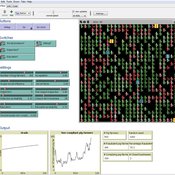
Simulation model for compliance behaviour
Esther Van Asselt Sjoukje A Osinga | Published Friday, October 03, 2014 | Last modified Tuesday, December 08, 2015This model can be used to optimize intervention strategies for inspection services.
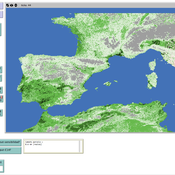
Cultural Spread
Salvador Pardo Gordó Salvador Pardo-Gordó | Published Thursday, April 02, 2015 | Last modified Thursday, April 23, 2020The purpose of the model is to simulate the cultural hitchhiking hypothesis to explore how neutral cultural traits linked with advantageous traits spread together over time
Cooperation Under Resources Pressure (CURP)
María Pereda José Manuel Galán Ordax José Santos | Published Monday, November 21, 2016 | Last modified Wednesday, April 25, 2018This is an agent-based model designed to explore the evolution of cooperation under changes in resources availability for a given population
Lakeland 2 is a simple version of the original Lakeland of Jager et al. (2000) Ecological Economics 35(3): 357-380. The model can be used to explore the consequences of different behavioral assumptions on resource and social dynamics.
Displaying 10 of 554 results for "Viet Cao" clear search