Our mission is to help computational modelers develop, document, and share their computational models in accordance with community standards and good open science and software engineering practices. Model authors can publish their model source code in the Computational Model Library with narrative documentation as well as metadata that supports open science and emerging norms that facilitate software citation, computational reproducibility / frictionless reuse, and interoperability. Model authors can also request private peer review of their computational models. Models that pass peer review receive a DOI once published.
All users of models published in the library must cite model authors when they use and benefit from their code.
Please check out our model publishing tutorial and feel free to contact us if you have any questions or concerns about publishing your model(s) in the Computational Model Library.
Displaying 10 of 1229 results for "Lee-Ann Sutherland" clear search
Obligation norm identification in multi-agent societies
Tony Savarimuthu | Published Tuesday, June 29, 2010 | Last modified Saturday, April 27, 2013This model describes a mechanism by which software agents can identify norms in an artificial agent society. In particular, this model uses a sequence mining approach to identify norms in an agent soc
Social Nets Emergence Model
Di Wang | Published Wednesday, March 21, 2012 | Last modified Saturday, April 27, 2013This model simulates the interactions and dynamic trust changes between people which results in social group emergence and evolution.
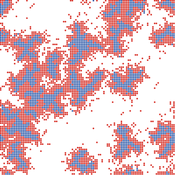
Increased costs of cooperation help cooperators in the long run
Paul Smaldino | Published Wednesday, March 01, 2017A spatial prisoner’s dilemma model with mobile agents, de-coupled birth-death events, and harsh environments.
Opinion dynamics model for prediction markets
Valerio Restocchi | Published Monday, July 31, 2023We introduce a model of prediction markets that uses opinion dynamics as its underlying mechanism for price formation. We base the opinion dynamics on the Deffuant model of bounded rationality. We have used this model to show that price formation in prediction markets can be robustly explained by opinion dynamics, and that the model can also explain phase transitions depending on just two parameters.
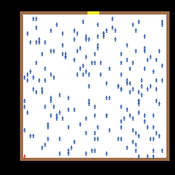
This model was design to test parameters that affects the number of people shot during mass shooting. This basic formulation places a gunman in a crowd and allows the users to manipulate parameters of the gunman.
Vole-Mustelid model
Viktoriia Radchuk Harry Peter Andreassen Rolf Anker Ims | Published Monday, October 07, 2019The model reflects the predator-prey mustelid-vole population dynamics, typically observed in boreal systems. The goal of the model is to assess which intrinsic and extrinsic factors (or factor combinations) are needed for the generation of the cyclic pattern typically observed in natural vole populations. This goal is achieved by contrasting the alternative model versions by “switching off” some of the submodels in order to reflect the four combinations of the factors hypothesized to be driving vole cycles.
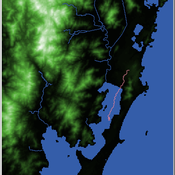
Shellmound Mobility
Henrique de Sena Kozlowski | Published Saturday, June 15, 2024Least Cost Path (LCP) analysis is a recurrent theme in spatial archaeology. Based on a cost of movement image, the user can interpret how difficult it is to travel around in a landscape. This kind of analysis frequently uses GIS tools to assess different landscapes. This model incorporates some aspects of the LCP analysis based on GIS with the capabilities of agent-based modeling, such as the possibility to simulate random behavior when moving. In this model the agent will travel around the coastal landscape of Southern Brazil, assessing its path based on the different cost of travel through the patches. The agents represent shellmound builders (sambaquieiros), who will travel mainly through the use of canoes around the lagoons.
How it works?
When the simulation starts the hiker agent moves around the world, a representation of the lagoon landscape of the Santa Catarina state in Southern Brazil. The agent movement is based on the travel cost of each patch. This travel cost is taken from a cost surface raster created in ArcMap to represent the different cost of movement around the landscape. Each tick the agent will have a chance to select the best possible patch to move in its Field of View (FOV) that will take it towards its target destination. If it doesn’t select the best possible patch, it will randomly choose one of the patches to move in its FOV. The simulation stops when the hiker agent reaches the target destination. The elevation raster file and the cost surface map are based on a 1 Arc-second (30m) resolution SRTM image, scaled down 5 times. Each patch represents a square of 150m, with an area of 0,0225km². The dataset uses a UTM Sirgas 2000 22S projection system. There are four different cost functions available to use. They change the cost surface used by the hikers to navigate around the world.
ergodicity_test
Jakob Grazzini | Published Monday, November 29, 2010 | Last modified Saturday, April 27, 2013This Python module contain a function that is able to test the ergodicity of a given agent based model. It is sufficient to produce one long time series and many smaller time series. The function uses
A model of opinion dynamics based on formal argumentation: application to the diffusion of the vegetarian diet
Patrick Taillandier Nicolas Salliou Rallou Thomopoulos | Published Monday, March 15, 2021 | Last modified Wednesday, January 07, 2026This generic agent-based model simulates the evolution of agent’s opinions through their exchange of arguments.
The idea behind this model is to explicitly represent the process of mental deliberation of agents from arguments to an opinion, through the use of Dung’s argumentation framework complemented by a structured description of arguments. An application of the model on the diffusion of vegetarian diets is proposed.
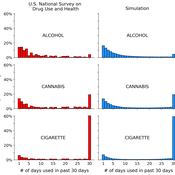
A simple computational algorithm for simulating population substance use
Jacob Borodovsky | Published Thursday, March 27, 2025This code simulates individual-level, longitudinal substance use patterns that can be used to understand how cross-sectional U-shaped distributions of population substance use emerge. Each independent computational object transitions between two states: using a substance (State 1), or not using a substance (State 2). The simulation has two core components. Component 1: each object is assigned a unique risk factor transition probability and unique protective factor transition probability. Component 2: each object’s current decision to use or not use the substance is influenced by the object’s history of decisions (i.e., “path dependence”).
Displaying 10 of 1229 results for "Lee-Ann Sutherland" clear search