Our mission is to help computational modelers develop, document, and share their computational models in accordance with community standards and good open science and software engineering practices. Model authors can publish their model source code in the Computational Model Library with narrative documentation as well as metadata that supports open science and emerging norms that facilitate software citation, computational reproducibility / frictionless reuse, and interoperability. Model authors can also request private peer review of their computational models. Models that pass peer review receive a DOI once published.
All users of models published in the library must cite model authors when they use and benefit from their code.
Please check out our model publishing tutorial and feel free to contact us if you have any questions or concerns about publishing your model(s) in the Computational Model Library.
Displaying 10 of 214 results behavior clear search
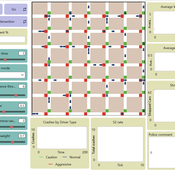
Amber Dilemma Zone: Driver Cognition and Signal Control in Urban Traffic
Mansoor Abdul Bari | Published Sunday, July 19, 2026This model is an extension of Wilensky’s (2003) Traffic Grid, a foundational NetLogo model of urban traffic flow. It embeds a dual-process cognitive architecture into each driver agent, transforming the original’s identical reactive units into cognitively heterogeneous individuals whose internal mental state evolves with experience; making the same intersection produce different decisions from different drivers, and different decisions from the same driver across occasions.
The core question the model addresses is the yellow-light dilemma zone: the seconds following amber onset in which a driver can neither stop safely nor clear the intersection before red. Field research documents that behavioral variance at this moment cannot be explained by geometry or legal obligation alone. This model provides the cognitive architecture that has been missing from traffic ABMs.
Each driver routes every amber-onset decision through either System 1 (fast, heuristic, automatic) or System 2 (slow, deliberative, prospect-theoretic), switching dynamically based on cognitive load, accumulated near-miss memory, and situational framing. The result is crash outcomes that are attributable, path-dependent, and sensitive to both driver disposition and signal infrastructure; none of which fixed-rule models can reproduce. Three signal control modes are included: fixed-cycle (replicating Wilensky’s original), adaptive-queue, and smart occupancy-based switching.
ABMIND: An Empirically Informed Agent-Based Model of Psychological Distance and Environmental Protection Behavior
Wenhan Feng | Published Saturday, June 13, 2026ABMIND, the Agent-Based Model of Individual Psychological Distance, is a modeling framework developed to examine how psychological distance influences environmental protection behavior in coastal farming communities in southern China. Using household survey data and empirically estimated behavioral pathways, the model represents how uncertainty shapes four dimensions of psychological distance, namely temporal, spatial, social and hypothetical distance, and how these dimensions guide protection and degradation decisions. Agents include households, government actors and mangrove ecosystem patches, connected through social networks and ecological feedbacks that affect learning, expectations and perceived benefits. Policy interventions such as rewards, penalties and publicity guidance efforts work by modifying uncertainty and psychological distance rather than directly controlling behavior. ABMIND is implemented as a spatially explicit model following the ODD protocol, and a concise user guide is provided. In developing ABMIND we introduce a structured validation workflow that links statistical mediation analysis with simulation-based diagnostics, allowing empirical cognitive mechanisms to be systematically embedded and tested within the ABM. This integrated approach strengthens the credibility of psychological-mechanism models and supports their use in policy evaluation. The framework offers a methodological platform for integrating cognitive mechanisms into agent-based environmental behavior modeling and for evaluating policy strategies that support ecosystem protection.
Model paper:
ABMIND: An empirically informed agent-based model of psychological distance and environmental protection behaviour
Ecological Modelling
https://doi.org/10.1016/j.ecolmodel.2026.111700
Aquarium
Yunshuo Tang | Published Tuesday, May 26, 2026This model simulates a simple aquatic ecosystem containing fish and food. It explores how individual interactions such as movement, feeding, and reproduction shape the population dynamics of fish over time.
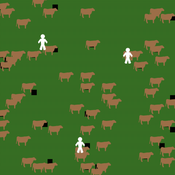
MASTOC-LLM (Multi-Agent System Tragedy of the Commons - Large Language Models)
Thomas Tuoti | Published Monday, May 18, 2026 | Last modified Tuesday, May 19, 2026MASTOC-LLM extends the classic Multi-Agent System Tragedy of the Commons (MASTOC) model by replacing hard-coded behavioral rules with autonomous decision-making powered by large language models (LLMs). Three heterogeneous agents manage herds of cows on a shared grassland commons. Each tick, an agent receives a structured prompt describing current resource levels, its own herd size, peer behavior, and — optionally — a rolling memory of recent rounds and messages from neighboring agents. The LLM returns a stocking decision (add, remove, or hold cows) together with a natural-language rationale and, when communication is enabled, a short message to broadcast to peers.
The model is designed to test whether LLM agents spontaneously develop Ostrom-style common-pool resource governance (mutual monitoring, graduated sanctions, graduated rule revision) or instead fall into identifiable failure modes. Preliminary experiments with Claude Haiku 4.5, GPT-5.4-mini, and DeepSeek R1:32b have revealed four recurring collapse patterns — Cooperative Paralysis, Defection Cascade, Overshoot-Panic, and Hybrid Architecture Failure — whose onset timing is sensitive to memory length, inter-agent communication, and the post-training alignment approach of the underlying model.
MASTOC-LLM is intended as a laboratory for generative agent-based modelling (GABM) methodology: it provides a clean, well-understood commons baseline against which LLM behavioral hypotheses can be systematically tested and compared across models, parameter sweeps, and alignment regimes.
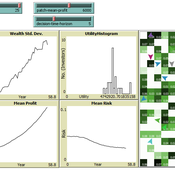
Peer reviewed Integrating Reinforcement Learning in Agent-Based Modeling for Dynamic Investment Decisions
Muhammad Khurram Ali Haider Ali Hafiz Mohammad | Published Tuesday, May 05, 2026This model is a part of an ongoing research project on Multiagent Reinforcement Learning (MARL). The ODD protocol is included in the model. In this version of the model, Proximal Policy Optimization (PPO) is designed in the agent behaviors. It also includes a designed experiment in its Behavior Space which is used in the Response Surface Methodology and training of an Artificial Neural Network (ANN) based Recommender System.
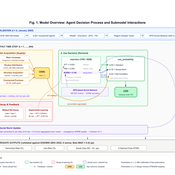
Peer reviewed Kenya ITN Agent-Based Microsimulation (2003–2024)
Wooyoung Kim Hosang Shin | Published Saturday, April 18, 2026 | Last modified Tuesday, June 16, 2026An agent-based microsimulation of insecticide-treated net (ITN) distribution and adoption in Kenya (2003–2024), integrating the Theory of Planned Behaviour, Rogers diffusion, Weibull net decay, and a GPS-based two-layer social network. 8,561 household agents calibrated via Approximate Bayesian Computation to six DHS/MIS survey waves, achieving 2.42 pp mean absolute error on Kenya-level ownership. The analysis chain supports mechanism counterfactuals and policy experiments on equity outcomes of ITN distribution strategies.
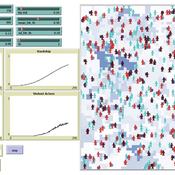
Simulating Climate Stress and Social Instability: An Agent-Based Model of Ecosystem Degradation and Violence in Coastal Communities
Jacopo A. Baggio hurtado-valdivieso | Published Sunday, April 12, 2026This model is an agent-based simulation designed to explore how climate-induced environmental degradation can contribute to the emergence of social violence in coastal communities that depend heavily on ecosystem services for their livelihoods. The model represents a coupled social–ecological system in which environmental shocks—such as sea level rise and marine ecosystem decline—affect local economic conditions, food security, and community stability.
Agents in the model represent individuals whose livelihoods depend on coastal ecosystems. Environmental degradation reduces ecosystem productivity and increases economic hardship, which can lead to the formation of grievances among agents. The model incorporates behavioral thresholds that determine how individuals respond to hardship and perceived injustice. Under certain conditions—particularly when institutional capacity and law enforcement effectiveness are limited—these grievances may escalate into violent behavior.
The simulation allows users to explore how different climate scenarios, levels of ecosystem degradation, livelihood dependence, and institutional responses influence the probability of social instability and violence. By modeling the interactions between environmental stress, socio-economic vulnerability, and governance capacity, the model provides a computational framework for examining potential pathways linking climate change and conflict in coastal social–ecological systems.
…
VIBE (Visible and Interconnected Behavioral Expectations Model)
Wenhan Feng | Published Friday, March 20, 2026This model aims to study the dynamic propagation of individual behaviour within social networks, focusing on how normative expectations (NE) and experiential expectations (EE) jointly influence behavioural decisions. It also explores the long-term effects of different intervention scenarios (such as enhancing visibility, considering indirect social links, and education) on behavioural propagation patterns and the overall behaviour of the group.
The model was developed in NetLogo 6.4. It generates simulated groups based on large-scale survey data, utilizing NetLogo’s CSV, Table, and Matrix extensions. The model also employs the NW extension to enable network analysis functionality.
The model is designed for research “Shaping social norms to promote individual response behavior in public crises: An agent-based modeling approach” in Journal of Cleaner Production, Volume 554, 8 April 2026, 148014
https://doi.org/10.1016/j.jclepro.2026.148014
Selective Depolarization by Endogenous Migration in Attraction-Repulsion Opinion Dynamics (NetLogo)
poyeker | Published Tuesday, February 17, 2026This model implements a coupled opinion-mobility agent-based framework in NetLogo, extending Attraction-Repulsion Model (ARM) dynamics with endogenous migration in continuous 2D space.
Each agent has an opinion s in [0,1] and a spatial position (x,y). Agents interact locally within an interaction radius, with exposure-controlled interaction probability. Opinion updates follow ARM rules: attraction for small opinion distance and repulsion for large distance (tolerance threshold T). After social interaction, agents move according to a social-force mechanism that balances attraction to similar neighbors and avoidance of dissimilar neighbors, controlled by orientation bias (approaching goods vs leaving bads). The model also includes an optional exposure-mobility coupling setting.
Main outputs include polarization (P), spatial assortativity (Moran’s I), mixed-neighbor fraction (f_mix), and good-component count (N_g). The model is designed to study phase behavior of polarization and segregation under mobility and tolerance heterogeneity.
…
Peer reviewed Online Protest and Repression in Authoritarian Settings (OPRAS)
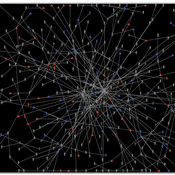
Nanda Wijermans Annie Waldherr Aytalina Kulichkina | Published Tuesday, January 27, 2026 | Last modified Tuesday, April 07, 2026This agent-based model, developed for the study “Online Protest and Repression in Authoritarian Settings,” examines how online protest and repression evolve in authoritarian contexts and how these dynamics affect ordinary users’ attitudes and behavior on social media. The model integrates key theoretical and empirical insights into social media use and core political factors that shape digital contention in authoritarian settings. The following questions are addressed: (1) how online protest–repression dynamics unfold across different levels of authoritarianism and varying compositions of committed accounts, and (2) how ordinary users’ internal propensity to protest and their perceived probability of successful repression change during online protest-repression contestation. The model is evaluated against two empirically grounded macro patterns observed in the real world. The first is enduring protest: online protest becomes dominant as vocal protesters grow to outnumber vocal repressors, shrinking the pool of silent users and stabilizing a pro-protest majority. The second is suppressed protest: online dissent is contained as vocal repression and silence expand in response to protest, yielding a sustained majority of repressive and silent accounts. Together, these dynamics demonstrate how dissenting voices are empowered and suppressed online in authoritarian settings.
Displaying 10 of 214 results behavior clear search