Computational Model Library

NOMAD: Near–Off Mobility under Aspiration Dynamics (1.0.0)

NOMAD is an agent-based model of firm location choice between two aggregate regions (“near” and “off”) under logistics uncertainty. Firms occupy sites characterised by attractiveness and logistics risk, earn a risk-adjusted payoff that depends on regional costs (wages plus congestion) and an individual risk-tolerance trait, and update location choices using aspiration-based satisficing rules with switching frictions. Logistics risk evolves endogenously on occupied sites through a region-specific absorption mechanism (good/bad events that reduce/increase risk), while congestion feeds back into regional costs via regional shares and local crowding. Runs stop endogenously once the near-region share becomes quasi-stable after burn-in, and the model records time series and quasi-stable outcomes such as near/off composition, switching intensity, costs, average risk, and average risk tolerance.
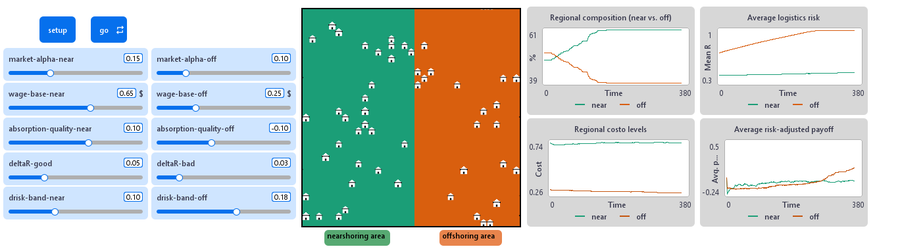
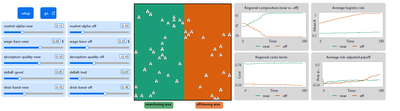
NOMAD_interface.png

Release Notes

This version includes the full two-region environment, patch-level attractiveness and logistics-risk attributes, aspiration-based location updating with within-region exploration and inter-regional switching frictions, endogenous logistics-risk absorption dynamics, congestion-based regional cost feedbacks, adaptive risk-tolerance learning, and an endogenous stopping rule that detects quasi-stable near/off configurations after burn-in.

Associated Publications

Ongoing

NOMAD: Near–Off Mobility under Aspiration Dynamics 1.0.0

NOMAD is an agent-based model of firm location choice between two aggregate regions (“near” and “off”) under logistics uncertainty. Firms occupy sites characterised by attractiveness and logistics risk, earn a risk-adjusted payoff that depends on regional costs (wages plus congestion) and an individual risk-tolerance trait, and update location choices using aspiration-based satisficing rules with switching frictions. Logistics risk evolves endogenously on occupied sites through a region-specific absorption mechanism (good/bad events that reduce/increase risk), while congestion feeds back into regional costs via regional shares and local crowding. Runs stop endogenously once the near-region share becomes quasi-stable after burn-in, and the model records time series and quasi-stable outcomes such as near/off composition, switching intensity, costs, average risk, and average risk tolerance.

Release Notes

This version includes the full two-region environment, patch-level attractiveness and logistics-risk attributes, aspiration-based location updating with within-region exploration and inter-regional switching frictions, endogenous logistics-risk absorption dynamics, congestion-based regional cost feedbacks, adaptive risk-tolerance learning, and an endogenous stopping rule that detects quasi-stable near/off configurations after burn-in.

Version Submitter First published Last modified Status
1.0.0 Alejandro Platas López Wed Dec 17 00:10:40 2025 Wed Dec 17 00:20:36 2025 Published

Discussion

This website uses cookies and Google Analytics to help us track user engagement and improve our site. If you'd like to know more information about what data we collect and why, please see our data privacy policy. If you continue to use this site, you consent to our use of cookies.
Accept