Our mission is to help computational modelers develop, document, and share their computational models in accordance with community standards and good open science and software engineering practices. Model authors can publish their model source code in the Computational Model Library with narrative documentation as well as metadata that supports open science and emerging norms that facilitate software citation, computational reproducibility / frictionless reuse, and interoperability. Model authors can also request private peer review of their computational models. Models that pass peer review receive a DOI once published.
All users of models published in the library must cite model authors when they use and benefit from their code.
Please check out our model publishing tutorial and feel free to contact us if you have any questions or concerns about publishing your model(s) in the Computational Model Library.
Displaying 10 of 150 results for "Simon Sharpe" clear search
Peer reviewed STiMUS: A Stigmergic–Mutualistic Agent-Based Model of Teamwork on Shared Digital Artefacts (IMOI)
Yevgeny Patarakin | Published Friday, July 03, 2026 | Last modified Wednesday, July 22, 2026STiMUS (Stigmergic–Mutualistic IMOI Model) is an agent-based model of teamwork in socio-technical systems where contributors collaborate through shared digital artefacts — wiki pages, code files, issue tickets, project cards, Scratch projects — represented as patches in a NetLogo world. The model integrates two coordination mechanisms. Stigmergy is indirect coordination through traces left in a shared environment: each edit deposits a pheromone that diffuses to neighbouring patches and evaporates over time, so recent activity attracts further contributions. Mutualism is a reciprocal benefit loop in which valuable, well-maintained artefacts raise contributor motivation and shared understanding, while motivated contributors improve artefacts.
Contributors (turtles of the contributor breed) carry individual state: skill, motivation, shared-mental-model, specialty, benefit-gain, and an explicit-mode flag. At each tick every contributor selects a target artefact with an ant-colony-optimization-style rule weighing the artefact’s pheromone, incompleteness (1 - completeness), resource-value, and topic match between specialty and the artefact’s topic-tag; with probability p-explicit it instead takes the patch with the highest maintenance-need, modelling explicit task assignment. Each edit increases pheromone, quality, completeness and reuse-count, raises resource-value, lowers maintenance-need, and appends the editor to the artefact’s edit-authors list. When the previous last-editor-id differs from the current editor, the Edit Succession Ratio rises, the editor’s shared-mental-model grows, and a co-editing link is created — operationalising the idea that repeated cross-author succession on the same artefact builds shared understanding. Contributors’ motivation is updated from the benefit drawn from the visited artefact.
Each patch maintains a stigmergic layer (pheromone, quality, completeness, recentness, last-editor-id, edit-count, edit-authors) and a mutualistic layer (resource-value, reuse-count, maintenance-need, topic-tag), plus task flags (is-task?, task-complexity). Global monitors report the Edit Succession Ratio (ESR = cross-author-edits / total-edits, and an alternative esr-value = share of edited patches with more than one distinct author), mean-quality, mean-resource-value, a mutualism-index averaging contributor benefit and resource value, coediting-density (network density of the co-editing graph), active-pages-share, and task-completion-rate. The model logs every edit as a bipartite edge (tick, author_id, pageid, specialty, topic_tag, quality), exportable to CSV.
…
The Internal Organizational Plasticity Model (IOP 2.1.2)
Davide Secchi | Published Tuesday, June 02, 2020IOP 2.1.2 is an agent-based simulation model designed to explore the relations between (1) employees, (2) tasks and (3) resources in an organizational setting. By comparing alternative cognitive strategies in the use of resources, employees face increasingly demanding waves of tasks that derive by challenges the organization face to adapt to a turbulent environment. The assumption tested by this model is that a successful organizational adaptation, called plastic, is necessarily tied to how employees handle pressure coming from existing and new tasks. By comparing alternative cognitive strategies, connected to ‘docility’ (Simon, 1993; Secchi, 2011) and ‘extended’ cognition (Clark, 2003, Secchi & Cowley, 2018), IOP 2.1.2 is an attempt to indicate which strategy is most suitable and under which scenario.
This agent-based model (ABM), developed in NetLogo and available on the COMSES repository, simulates a stylized, competitive electricity market to explore the effects of carbon pricing policies under conditions of technological innovation. Unlike traditional models that treat innovation as exogenous, this ABM incorporates endogenous innovation dynamics, allowing clean technology costs to evolve based on cumulative deployment (Wright’s Law) or time (Moore’s Law). Electricity generation companies act as agents, making investment decisions across coal, gas, wind, and solar PV technologies based on expected returns and market conditions. The model evaluates three policy scenarios—No Policy, Emissions Trading System (ETS), and Carbon Tax—within a merit-order market framework. It is partially empirically grounded, using real-world data for technology costs and emissions caps. By capturing emergent system behavior, this model offers a flexible and transparent tool for analyzing the transition to low-carbon electricity systems.
Peer reviewed Share: bottom-up disaster information management
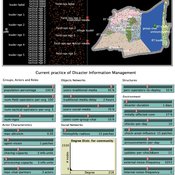
Vittorio Nespeca Tina Comes Frances Brazier | Published Monday, December 05, 2022This model is intended to study the way information is collectively managed (i.e. shared, collected, processed, and stored) in a system and how it performs during a crisis or disaster. Performance is assessed in terms of the system’s ability to provide the information needed to the actors who need it when they need it. There are two main types of actors in the simulation, namely communities and professional responders. Their ability to exchange information is crucial to improve the system’s performance as each of them has direct access to only part of the information they need.
In a nutshell, the following occurs during a simulation. Due to a disaster, a series of randomly occurring disruptive events takes place. The actors in the simulation need to keep track of such events. Specifically, each event generates information needs for the different actors, which increases the information gaps (i.e. the “piles” of unaddressed information needs). In order to reduce the information gaps, the actors need to “discover” the pieces of information they need. The desired behavior or performance of the system is to keep the information gaps as low as possible, which is to address as many information needs as possible as they occur.
Weighted Balance Model of Issue Alignment and Polarization
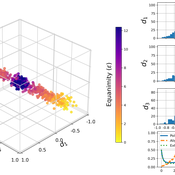
David Garcia Simon Schweighofer | Published Sunday, October 08, 2023This model is pertinent to our JASSS publication “Raising the Spectrum of Polarization: Generating Issue Alignment with a Weighted Balance Opinion Dynamics Model”. It shows how, based on the mechanisms of our Weighted Balance Theory (a development of Fritz Heider’s Cognitive Balance Theory), agents can self-organize in a multi-dimensional opinion space and form an emergent ideological spectrum. The degree of issue alignment and polarization realized by the model depends mainly on the agent-specific ‘equanimity parameter’ epsilon.
Peer reviewed Green Consumption Tipping Point
Mario | Published Thursday, February 26, 2026This model is a minimal agent-based model (ABM) of green consumption and market tipping dynamics in a stylised two-firm economy. It is designed as an existence proof to illustrate how weak individual preferences, when combined with habit formation, social influence, and firm price adaptation, can generate non-linear transitions (tipping points) in market outcomes.
The economy consists of:
1) Two firms, each supplying a differentiated consumption bundle that differs in its fixed green share (one relatively greener, one less green).
2) Many households, each consuming a unit mass per period and allocating consumption between the two firms.
…
Digital-Twin model of Sejong City
Tae-Sub Yun | Published Wednesday, August 31, 2022Digital-Twin model of Sejong City – Source model code & data
We only shared model codes, excluding private data and simulation engine codes.
The followings are brief reasons for the items we cannot share.
- Residence address data
…
NOMAD: Near–Off Mobility under Aspiration Dynamics
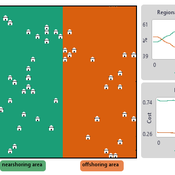
Alejandro Platas López | Published Wednesday, December 17, 2025NOMAD is an agent-based model of firm location choice between two aggregate regions (“near” and “off”) under logistics uncertainty. Firms occupy sites characterised by attractiveness and logistics risk, earn a risk-adjusted payoff that depends on regional costs (wages plus congestion) and an individual risk-tolerance trait, and update location choices using aspiration-based satisficing rules with switching frictions. Logistics risk evolves endogenously on occupied sites through a region-specific absorption mechanism (good/bad events that reduce/increase risk), while congestion feeds back into regional costs via regional shares and local crowding. Runs stop endogenously once the near-region share becomes quasi-stable after burn-in, and the model records time series and quasi-stable outcomes such as near/off composition, switching intensity, costs, average risk, and average risk tolerance.
Shared Norms and the Evolution of Ethnic Markers
Nathan Rollins | Published Friday, January 22, 2010 | Last modified Saturday, April 27, 2013The publication and mathematical model upon which this ABM is based shows one mechanism that can lead to stable behavioral and cultural traits between groups.
Bayesian Updating Opinion Shared Uncertainty Model.
Johnathan Adams | Published Monday, November 16, 2020 | Last modified Friday, May 14, 2021This is an opinion dynamics model which extends the model found in (Martins 2009). The previous model had an unshared uncertainty assumption in agent-to-agent interaction this model relaxes that assumption. The model only supports a fully connect network where every agent has an equal likelihood of interacting with every other agent at any given time step. The model is highly modular so different social network paradigm can easier be implemented.
Displaying 10 of 150 results for "Simon Sharpe" clear search