Our mission is to help computational modelers develop, document, and share their computational models in accordance with community standards and good open science and software engineering practices. Model authors can publish their model source code in the Computational Model Library with narrative documentation as well as metadata that supports open science and emerging norms that facilitate software citation, computational reproducibility / frictionless reuse, and interoperability. Model authors can also request private peer review of their computational models. Models that pass peer review receive a DOI once published.
All users of models published in the library must cite model authors when they use and benefit from their code.
Please check out our model publishing tutorial and feel free to contact us if you have any questions or concerns about publishing your model(s) in the Computational Model Library.
Displaying 7 of 37 results social influence clear search
An Agent-Based Model of Collective Action
Hai-Hua Hu | Published Tuesday, August 20, 2013We provide an agent-based model of collective action, informed by Granovetter (1978) and its replication model by Siegel (2009). We use the model to examine the role of ICTs in collective action under different cultural and political contexts.
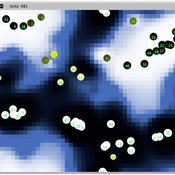
DIAL is a model of group dynamics and opinion dynamics. It features dialogues, in which agents put their reputation at stake. Intra-group radicalisation of opinions appears to be an emergent phenomenon.
Linear Threshold
Kaushik Sarkar | Published Saturday, November 03, 2012 | Last modified Saturday, April 27, 2013NetLogo implementation of Linear Threshold model of influence propagation.
Will it spread or not? The effects of social influences and network topology on innovation diffusion
Sebastiano Delre | Published Monday, October 24, 2011 | Last modified Saturday, April 27, 2013This models simulates innovation diffusion curves and it tests the effects of the degree and the direction of social influences. This model replicates, extends and departs from classical percolation models.
Diffusion dynamics in small-world networks with heterogeneous consumers
Sebastiano Delre | Published Saturday, September 10, 2011 | Last modified Saturday, April 27, 2013This model simulates diffusion curves and it allows to test how social influence, network structure and consumer heterogeneity affect their spreads and their speeds.
Nudging agents in social networks for collective action
Marco Janssen | Published Sunday, August 14, 2011 | Last modified Sunday, March 17, 2019Agents are linked in a social-network and make decisions on which of 2 types of behavior to adopt. We explore consequences of different information feedback and providing targeted feedback to individuals.
Simulating the Cinema Market: How Cross-Cultural Differences in Social Influence Explain Box Office Distributions
Sebastiano Delre | Published Thursday, February 11, 2010 | Last modified Saturday, April 27, 2013This model simulates the motion picture industry and tests how social influences affect market shares. It is empirically validated at the micro level by a cross-cultural survey.
Displaying 7 of 37 results social influence clear search