Our mission is to help computational modelers develop, document, and share their computational models in accordance with community standards and good open science and software engineering practices. Model authors can publish their model source code in the Computational Model Library with narrative documentation as well as metadata that supports open science and emerging norms that facilitate software citation, computational reproducibility / frictionless reuse, and interoperability. Model authors can also request private peer review of their computational models. Models that pass peer review receive a DOI once published.
All users of models published in the library must cite model authors when they use and benefit from their code.
Please check out our model publishing tutorial and feel free to contact us if you have any questions or concerns about publishing your model(s) in the Computational Model Library.
Displaying 10 of 459 results simulation clear search
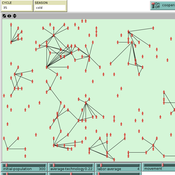
Coalitions in Networked Innovation
Rory Sie Peter Sloep Marlies Bitter-Rijpkema | Published Tuesday, February 11, 2014A first version of a model that describes how coalitions are formed during open, networked innovation
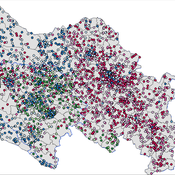
PSMED - Patagonia Simple Model of Ethnic Differentiation
Xavier Vilà Joan A Barceló J A Cuesta Florencia Del Castillo Ricardo Del Olmo José M Galán Laura Mameli Francisco J Miguel David Poza José I Santos | Published Tuesday, December 10, 2013Patagonia PSMED is an agent-based model designed to study a simple case of Evolution of Ethnic Differentiation. It replicates how can hunter-gatherer societies evolve and built cultural identities as a consequence of the way they interacted.
Mobility USA (MUSA)
Giangiacomo Bravo Davide Natalini | Published Sunday, December 08, 2013 | Last modified Monday, December 30, 2013MUSA is an ABM that simulates the commuting sector in USA. A multilevel validation was implemented. Social network with a social-circle structure included. Two types of policies have been tested: market-based and preference-change.
This is the final version of the model. To simulate the normative dynamics we used the EmIL (EMergence In the Loop) Framework which was kindly provided by Ulf Lotzmann. http://cfpm.org/EMIL-D5.1.pdf
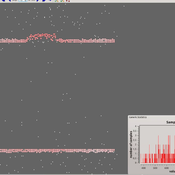
Gunpowder battle tactics
Xavier Rubio-Campillo Jose María Cela Francesc Xavier Hernàndez | Published Wednesday, November 20, 2013 | Last modified Tuesday, November 26, 2013This model simulates the dynamics of eighteenth-century infantry battle tactics. The goal is to explore the effect of different tactics and individual traits in the dynamics of the combat.
Social model of a Team Developing a Planning-Methodology
Oswaldo Terán Christophe Sibertin | Published Monday, November 18, 2013 | Last modified Sunday, November 16, 2014The model represents a team intended at designing a methodology for Institutional Planning. Included in ICAART’14 to exemplify how emotions can be identified in SocLab; and in ESSA’14 to show the Efficiency of Organizational Withdrawal vs Commitment.
PR-M: The Peer Review Model
Mario Paolucci Francisco Grimaldo | Published Sunday, November 10, 2013 | Last modified Wednesday, July 01, 2015This is an agent-based model of peer review built on the following three entities: papers, scientists and conferences. The model has been implemented on a BDI platform (Jason) that allows to perform both parameter and mechanism exploration.
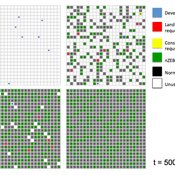
Exploring Transitions towards Sustainable Construction
Jesus Rosales-Carreon César García-Díaz | Published Wednesday, October 30, 2013 | Last modified Saturday, January 31, 2015This model illustrates actor interaction in the construction sector, according to information gathered in NL. It offers a simple frame to represent diverse interests, interdependencies and effects on the number of built sustainable houses.
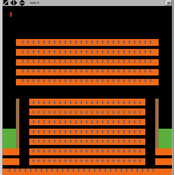
On July 20th, James Holmes committed a mass shooting in a midnight showing of The Dark Knight Rises. The Aurora Colorado shooting was used as a test case to validate this framework for modeling mass shootings.
OLIGO
Mason Wright | Published Thursday, October 24, 2013 | Last modified Monday, April 08, 2019A multi-agent model of oligarchy in a spatial election simulation.
Displaying 10 of 459 results simulation clear search