Our mission is to help computational modelers develop, document, and share their computational models in accordance with community standards and good open science and software engineering practices. Model authors can publish their model source code in the Computational Model Library with narrative documentation as well as metadata that supports open science and emerging norms that facilitate software citation, computational reproducibility / frictionless reuse, and interoperability. Model authors can also request private peer review of their computational models. Models that pass peer review receive a DOI once published.
All users of models published in the library must cite model authors when they use and benefit from their code.
Please check out our model publishing tutorial and feel free to contact us if you have any questions or concerns about publishing your model(s) in the Computational Model Library.
Displaying 10 of 954 results for "Am Vaes - Van De Hulsbeek" clear search
Diffusion of Eco-Innovation through Inter-firm Network Targeting: An Agent-Based Model
apyka Flaminio Squazzoni Shyaam Ramkumar Matthias Mueller | Published Monday, January 10, 2022This model is developed as a theoretical agent-based model to study the general phenomena of network-based targeting strategies on eco-innovation adoption and diffusion through inter-firm networks.
SiFlo: An Agent-based Model to simulate inhabitants’ behavior during a flood event
Patrick Taillandier Franck Taillandier Pascal Di Maiolo Rasool Mehdizadeh | Published Thursday, July 29, 2021SiFlo is an ABM dedicated to simulate flood events in urban areas. It considers the water flowing and the reaction of the inhabitants. The inhabitants would be able to perform different actions regarding the flood: protection (protect their house, their equipment and furniture…), evacuation (considering traffic model), get and give information (considering imperfect knowledge), etc. A special care was taken to model the inhabitant behavior: the inhabitants should be able to build complex reasoning, to have emotions, to follow or not instructions, to have incomplete knowledge about the flood, to interfere with other inhabitants, to find their way on the road network. The model integrates the closure of roads and the danger a flooded road can represent. Furthermore, it considers the state of the infrastructures and notably protection infrastructures as dyke. Then, it allows to simulate a dyke breaking.
The model intends to be generic and flexible whereas provide a fine geographic description of the case study. In this perspective, the model is able to directly import GIS data to reproduce any territory. The following sections expose the main elements of the model.
FLOSSSim: An Agent-Based Model of the Free/Libre Open Source Software (FLOSS) Development Process
Nicholas Radtke | Published Saturday, December 31, 2011 | Last modified Saturday, April 27, 2013An agent-based model of the Free/Libre Open Source Software (FLOSS) development process designed around agents selecting FLOSS projects to contribute to and/or download.
Linear Threshold
Kaushik Sarkar | Published Saturday, November 03, 2012 | Last modified Saturday, April 27, 2013NetLogo implementation of Linear Threshold model of influence propagation.
Peer reviewed Price Evolution with Expectations
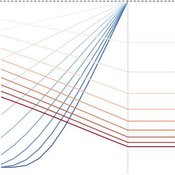
J M Applegate Gesine Steudel Armin Haas Carlo Jaeger | Published Friday, September 10, 2021The Price Evolution with Expectations model provides the opportunity to explore the question of non-equilibrium market dynamics, and how and under which conditions an economic system converges to the classically defined economic equilibrium. To accomplish this, we bring together two points of view of the economy; the classical perspective of general equilibrium theory and an evolutionary perspective, in which the current development of the economic system determines the possibilities for further evolution.
The Price Evolution with Expectations model consists of a representative firm producing no profit but producing a single good, which we call sugar, and a representative household which provides labour to the firm and purchases sugar.The model explores the evolutionary dynamics whereby the firm does not initially know the household demand but eventually this demand and thus the correct price for sugar given the household’s optimal labour.
The model can be run in one of two ways; the first does not include money and the second uses money such that the firm and/or the household have an endowment that can be spent or saved. In either case, the household has preferences for leisure and consumption and a demand function relating sugar and price, and the firm has a production function and learns the household demand over a set number of time steps using either an endogenous or exogenous learning algorithm. The resulting equilibria, or fixed points of the system, may or may not match the classical economic equilibrium.
Group assortment with preference rankings
Fredrik Jansson | Published Thursday, July 14, 2016 | Last modified Monday, April 09, 2018This model uses preference rankings w.r.t. ethnic group compositions (e.g. at companies) and assigns ethnic agents to groups based on their rankings.

How to not get stuck – an ant model showing how negative feedback due to crowding maintains flexibility in ant foraging
Tomer Czaczkes | Published Thursday, December 17, 2015Positive feedback can lead to “trapping” in local optima. Adding a simple negative feedback effect, based on ant behaviour, prevents this trapping
Hominin Ecodynamics v.1.1 (update for perception and interaction)
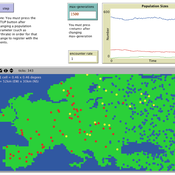
C Michael Barton | Published Wednesday, August 15, 2012 | Last modified Saturday, April 27, 2013Models land-use, perception, and biocultural interactions between two forager populations.
A model of urban expansion policy scenarios using an agent-based approach—a case of the Guangzhou Metropolitan Region of China
Guangjin Tian | Published Friday, March 21, 2014Three policy scenarios for urban expansion under the influences of the behaviours and decision modes of four agents and their interactions have been applied to predict the future development patterns of the Guangzhou metropolitan region.
Consumer diets and values ABM
Natalie Davis Merlin Radbruch Dean Bucciarelli | Published Thursday, December 22, 2022 | Last modified Wednesday, March 05, 2025An agent-based model of individual consumers making choices between five possible diets: omnivore, flexitarian, pescatarian, vegetarian, or vegan. Each consumer makes decisions based on personal constraints and values, and their perceptions of how well each diet matches with those values. Consumers can also be influenced by each other’s perceptions via interaction across three social networks: household members, friends, and acquaintances.
Displaying 10 of 954 results for "Am Vaes - Van De Hulsbeek" clear search