Our mission is to help computational modelers develop, document, and share their computational models in accordance with community standards and good open science and software engineering practices. Model authors can publish their model source code in the Computational Model Library with narrative documentation as well as metadata that supports open science and emerging norms that facilitate software citation, computational reproducibility / frictionless reuse, and interoperability. Model authors can also request private peer review of their computational models. Models that pass peer review receive a DOI once published.
All users of models published in the library must cite model authors when they use and benefit from their code.
Please check out our model publishing tutorial and feel free to contact us if you have any questions or concerns about publishing your model(s) in the Computational Model Library.
Displaying 10 of 26 results variability clear search
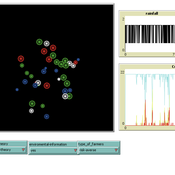
Modeling the decline of labor-sharing in highly variable environments
Marco Janssen Andres Baeza-Castro | Published Tuesday, April 02, 2019The rapid environmental changes currently underway in many dry regions of the world, and the deep uncertainty about their consequences, underscore a critical challenge for sustainability: how to maintain cooperation that ensures the provision of natural resources when the benefits of cooperating are variable, sometimes uncertain, and often limited. We present an agent-based model that simulates the economic decisions of households to engage, or not, in labor-sharing agreements under different scenarios of water supply, water variability, and socio-environmental risk. We formulate the model to investigate the consequences of environmental variability on the fate of labor-sharing agreements between farmers. The economic decisions were implemented in the framework of prospect theory.
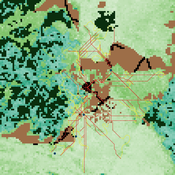
RaMDry - Rangeland Model in Drylands
Pascal Fust Eva Schlecht | Published Friday, January 05, 2018 | Last modified Friday, April 01, 2022RaMDry allows to study the dynamic use of forage ressources by herbivores in semi-arid savanna with an emphasis on effects of change of climate and management. Seasonal dynamics affects the amount and the nutritional values of the available forage.
Simulating the evolution of the human family
Paul Smaldino | Published Wednesday, November 29, 2017The (cultural) evolution of cooperative breeding in harsh environments.
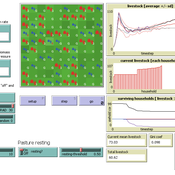
RAGE RAngeland Grazing Model
Carsten M Buchmann Jule Thober Birgit Müller Karin Frank Cheng Guo Jürgen Groeneveld Gunnar Dressler Niklas Hase | Published Monday, July 17, 2017 | Last modified Friday, October 26, 2018RAGE models a stylized common property grazing system. Agents follow a certain behavioral type. The model allows analyzing how household behavior with respect to a social norm on pasture resting affects long-term social-ecological system dynamics.
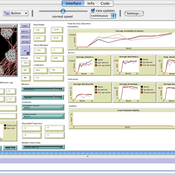
A Model to Unravel the Complexity of Rural Food Security
Stefano Balbi Samantha Dobbie | Published Monday, August 22, 2016 | Last modified Sunday, December 02, 2018An ABM to simulate the behaviour of households within a village and observe the emerging properties of the system in terms of food security. The model quantifies food availability, access, utilisation and stability.
Quality uncertainty and market failure
David Poza José Manuel Galán María Pereda José Santos | Published Wednesday, May 14, 2014 | Last modified Wednesday, April 25, 2018Quality uncertainty and market failure: an interactive model to conduct classroom experiments
ManPest
François Rebaudo | Published Tuesday, February 25, 2014 | Last modified Wednesday, August 27, 2014The purpose of the model is to explore the impacts of global change on the ability of a community of farmers to adapt their practices to an agricultural pest.
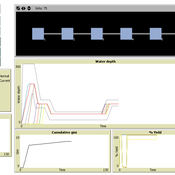
The purpose of the AdaptPumpa model is to analyze the robustness of the Pumpa irrigation system in Nepal to climate change.
The Evolution of Cooperation in an Ecological Context
Oyita Udiani | Published Saturday, November 03, 2012 | Last modified Saturday, April 27, 2013This is a replication of the altruistic trait selection model described in Pepper & Smuts (2000, 2002).
The effect of error on cultural transmission
Claudine Gravel-Miguel | Published Thursday, November 01, 2012 | Last modified Saturday, April 27, 2013This is the replication of the experiment performed by Eerkens and Lipo (2005) to look at the effect of copying errors when specific traits are transferred from an individual to another.
Displaying 10 of 26 results variability clear search