Our mission is to help computational modelers develop, document, and share their computational models in accordance with community standards and good open science and software engineering practices. Model authors can publish their model source code in the Computational Model Library with narrative documentation as well as metadata that supports open science and emerging norms that facilitate software citation, computational reproducibility / frictionless reuse, and interoperability. Model authors can also request private peer review of their computational models. Models that pass peer review receive a DOI once published.
All users of models published in the library must cite model authors when they use and benefit from their code.
Please check out our model publishing tutorial and feel free to contact us if you have any questions or concerns about publishing your model(s) in the Computational Model Library.
Displaying 10 of 1141 results for "Bin-Tzong Chi" clear search
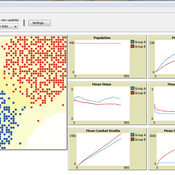
This model was developed to test the usability of evolutionary computing and reinforcement learning by extending a well known agent-based model. Sugarscape (Epstein & Axtell, 1996) has been used to demonstrate migration, trade, wealth inequality, disease processes, sex, culture, and conflict. It is on conflict that this model is focused to demonstrate how machine learning methodologies could be applied.
The code is based on the Sugarscape 2 Constant Growback model, availble in the NetLogo models library. New code was added into the existing model while removing code that was not needed and modifying existing code to support the changes. Support for the original movement rule was retained while evolutionary computing, Q-Learning, and SARSA Learning were added.
Lake Anderson Revisited II
Klaus G. Troitzsch | Published Monday, June 28, 2021The purpose of this study is another agent-based replication of a System Dynamics model (Anderson,1973) where he analysed the dynamics of nutrient, biomass, oxygen and detritus in a model lake under conditions of artificial fertilising and policies to deal with the consequences of artificial fertilising.. A first replication (Möhring & Troitzsch,2001) added those agents to the original model that were necessary to move the role of the experimenter into the model, whereas this replication replaces the original lake with a collection of small elements between which biomass, nurtrents and oxygen are exchanged, adds rivers upstream and downstream as well as adjacent land divided into villages and populated with farms and industrial plants run by individual persons.
An agent-based model of scapegoating
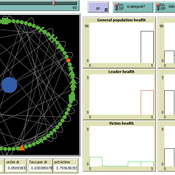
Carlos Paes | Published Thursday, August 28, 2025 | Last modified Thursday, August 28, 2025This agent-based model investigates scapegoating as a social mechanism of crisis management. Inspired by René Girard’s mimetic theory, it simulates how individual tension accumulates and spreads across a small-world network. When tension exceeds certain thresholds, leaders emerge and accuse marginalized agents, who may attempt to transfer blame to substitutes. If scapegoating occurs, collective tension decreases, but victims become isolated while leaders consolidate temporary authority. This simulation provides a conceptual and methodological framework for exploring how collective blame, crisis contagion, and leadership paradoxes emerge in complex networks. It can also be extended with empirical data, such as social media dynamics of online harassment and virtual lynching, offering potential applications for both theoretical research and practical crisis monitoring.
CITMOD A Tax-Benefit Modeling System for the average citizen
Philip Truscott | Published Monday, August 15, 2011 | Last modified Saturday, April 27, 2013Must tax-benefit policy making be limited to the ‘experts’?
Peer reviewed Strategy with Externalities
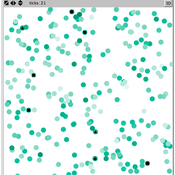
J M Applegate Glenn Hoetker | Published Thursday, December 21, 2017The SWE models firms search behaviour as the performance landscape shifts. The shift represents society’s pricing of negative externalities, and the performance landscape is an NK structure. The model is written in NetLogo.
01b ModEco NLG V1.39 – Model Economies – The PMM
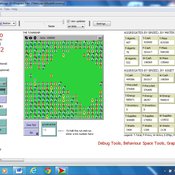
Garvin Boyle | Published Friday, April 14, 2017It is very difficult to model a sustainable intergenerational biophysical/financial economy. ModEco NLG is one of a series of models exploring the dynamics of sustainable economics – PSoup, ModEco, EiLab, OamLab, MppLab, TpLab, CmLab.
Modeling a Victim-Centered Approach for Detection of Human Trafficking Victims within Migration Flows
Kyle Ballard Brant M Horio | Published Saturday, September 23, 2017The model employs an agent-based model for exploring the victim-centered approach to identifying human trafficking and the approach’s effectiveness in an abstract representation of migrant flows.
The Effect of Merger and Acquisitions on the IS Function: An Agent Based Simulation Model
Andrea Genovese | Published Tuesday, June 23, 2009 | Last modified Saturday, April 27, 2013Merger and acquisition (M&A) activity has many strategic and operational objectives. One operational objective is to develop common and efficient information systems that maybe the source of creating
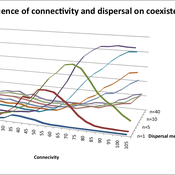
Varying effects of connectivity and dispersal on interacting species dynamics
Kehinde Salau | Published Monday, August 29, 2011 | Last modified Saturday, April 27, 2013An agent-based model of species interaction on fragmented landscape is developed to address the question, how do population levels of predators and prey react with respect to changes in the patch connectivity as well as changes in the sharpness of threshold dispersal?
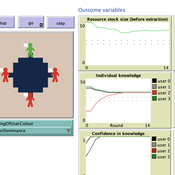
The purpose of the study is to unpack and explore a potentially beneficial role of sharing metacognitive information within a group when making repeated decisions about common pool resource (CPR) use.
We explore the explanatory power of sharing metacognition by varying (a) the individual errors in judgement (myside-bias); (b) the ways of reaching a collective judgement (metacognition-dependent), (c) individual knowledge updating (metacognition- dependent) and d) the decision making context.
The model (AgentEx-Meta) represents an extension to an existing and validated model reflecting behavioural CPR laboratory experiments (Schill, Lindahl & Crépin, 2015; Lindahl, Crépin & Schill, 2016). AgentEx-Meta allows us to systematically vary the extent to which metacognitive information is available to agents, and to explore the boundary conditions of group benefits of metacognitive information.
Displaying 10 of 1141 results for "Bin-Tzong Chi" clear search