Green Consumption Tipping Point 1.1.0
This model is a minimal agent-based model (ABM) of green consumption and market tipping dynamics in a stylised two-firm economy. It is designed as an existence proof to illustrate how weak individual preferences, when combined with habit formation, social influence, and firm price adaptation, can generate non-linear transitions (tipping points) in market outcomes.
The economy consists of:
1) Two firms, each supplying a differentiated consumption bundle that differs in its fixed green share (one relatively greener, one less green).
2) Many households, each consuming a unit mass per period and allocating consumption between the two firms.
Households maximise a utility function that includes:
1) Baseline consumption utility (log-linear over consumption shares),
2) Intrinsic preference for greenness,
3) Disutility from prices,
4) Disutility from embodied emissions,
5) Habit formation (preference for past consumption),
6) Peer influence (a social norm signal derived from past aggregate behaviour).
Firms set prices using a cost-plus pricing rule and adapt markups over time according to a Lerner-style benchmark, where the target markup depends on an estimated (arc) price elasticity of demand. Elasticity is inferred from recent price–quantity observations, and price adjustment is gradual to avoid instability.
Policy instruments
The model allows for two policy instruments:
1) A carbon tax on the brown (high-emissions) component of production,
2) A subsidy for the green (low-emissions) component.
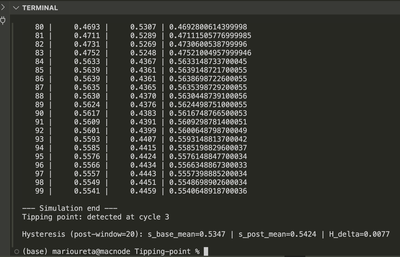
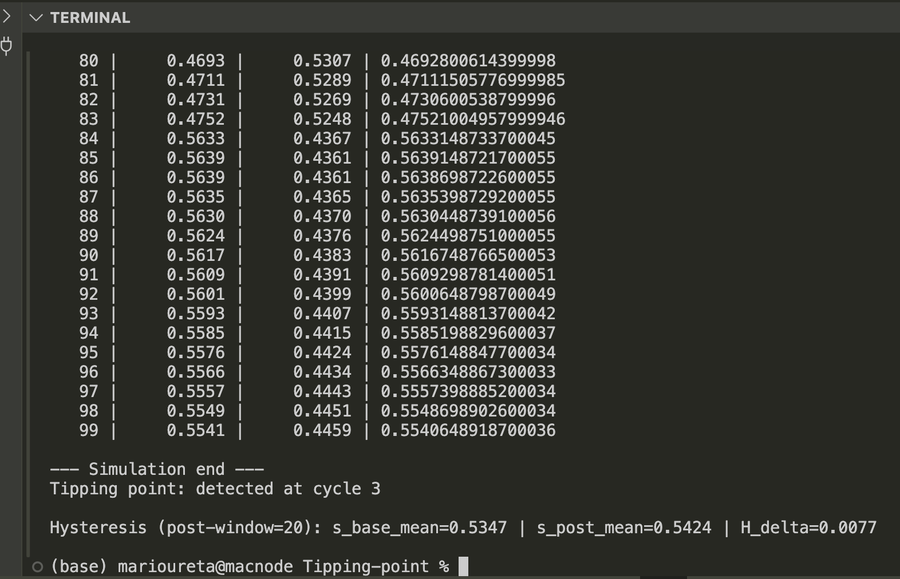
These instruments directly affect firms’ unit costs and therefore prices, creating cost pass-through. Policy can be switched on and off during the simulation, allowing the study of policy-induced tipping and post-policy persistence (hysteresis).
Dynamics and tipping
Each simulation cycle proceeds as follows:
1) Households observe prices, product greenness, emissions intensity, and a peer signal.
2) Households choose consumption shares via grid-search utility maximisation.
3) Habits are updated based on realised consumption.
4) Firm market shares are aggregated.
5) The peer signal for the next cycle is updated from current market shares.
6) Firms update prices based on current costs and estimated demand elasticity.
A tipping point is recorded when the market share of the greener firm exceeds a predefined threshold for a specified number of consecutive cycles, capturing both level and persistence conditions.
The model is intentionally simple and abstract. It is not calibrated for prediction, but rather to demonstrate how:
1) modest individual pro-environmental tastes,
2) social reinforcement,
3) habit persistence,
4) and firm price responses can interact to produce non-linear transitions in market structure under relatively weak policy interventions.
The model is particularly suited for studying tipping points and path dependence, analysing policy timing and reversibility, and for pedagogical illustration of feedback-driven dynamics in socio-economic systems.
All stochastic elements are controlled via explicit random number generators with user-defined seeds. Simulation runs are fully reproducible given identical parameter settings and seeds.
Release Notes
Added Output Results